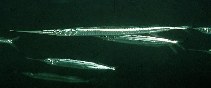
>
Beloniformes (Needle fishes) >
Belonidae (Needlefishes)
Etymology: Platybelone: Greek, platys = flat + Greek, belone = needle; any fish with sharp pointed snout; also Pierre Belon, 1517-64, French zoologist born in Le Mans. Professor at the College de France, author of " La nature et diversité des poissons", 1551 (Ref. 45335).
More on author: Bennett.
Issue
Considered mostly as a subspecies in the literature. Therefore the upraise at species rank here is considered as a provisionally accepted name, until more works are conducted on P. argalus susbepcies to fix their status.
Considered mostly as a subspecies in the literature. Therefore the upraise at species rank here is considered as a provisionally accepted name, until more works are conducted on P. argalus susbepcies to fix their status.
Environment: milieu / Zona climática / intervalo de profundidade / distribution range
Ecologia
marinhas associadas(os) a recifes; oceanódromo (Ref. 51243); intervalo de profundidade 0 - 2 m (Ref. 58302). Tropical; 27°N - 46°S, 51°E - 109°W
Indo-Pacific: East Africa to the Hawaiian and Tuamoto islands, north to the Ogasawara Islands. The subspecies platura from the Red Sea to Persian Gulf, platyura in the rest of the Indo-Pacific, and argalus in the tropical Atlantic (Ref. 37816).
Tamanho / Peso / Idade
Maturidade: Lm ? range ? - ? cm
Max length : 45.0 cm TL macho/indeterminado; (Ref. 89467); common length : 30.0 cm SL macho/indeterminado; (Ref. 30573)
Espinhos dorsais (total) : 0; Raios dorsais (total) : 12 - 15; Espinhos anais: 0; Raios anais : 15 - 20; Vértebras: 62 - 75. Gill rakers present; dorsal fin rays few, 12-15; caudal peduncle greatly depressed with very large keel on each side (Ref. 9682). See also Ref. 1602.
Body shape (shape guide): eel-like; Cross section: circular.
Inhabits offshore surface waters but is particularly abundant around islands (Ref. 9682). Probably the most common needlefish of reef flats, lagoons and bays where it occurs in groups of a few to several dozen. Carnivorous, feeding mainly on small fishes; marketed fresh (Ref. 9682). Oviparous (Ref. 205). Eggs may be found attached to objects in the water by tendrils on the egg's surface (Ref. 205).
Ciclo de vida ou comportamento de acasalamento
Maturidade | Reprodução | Desova | Ovos | Fecundidade | Larvas
Randall, J.E., G.R. Allen and R.C. Steene, 1990. Fishes of the Great Barrier Reef and Coral Sea. University of Hawaii Press, Honolulu, Hawaii. 506 p. (Ref. 2334)
Status na Lista Vermelha da UICN (Ref. 130435: Version 2025-1)
Ameaça para os humanos
Harmless
Uso pelos humanos
Pescarias: sem interesse; peixe esportivo: sim
Ferramentas
Relatórios especiais
Baixar XML
Fontes da internet
Estimates based on models
Preferred temperature (Ref.
123201): 26.3 - 29, mean 28 °C (based on 334 cells).
Índice de diversidade filogenética (Ref.
82804): PD
50 = 0.5078 [Uniqueness, from 0.5 = low to 2.0 = high].
Bayesian length-weight: a=0.00112 (0.00043 - 0.00289), b=3.05 (2.82 - 3.28), in cm total length, based on LWR estimates for this (Sub)family-body shape (Ref.
93245).
Nível Trófico (Ref.
69278): 4.2 ±0.73 se; based on food items.
Resiliência (Ref.
120179): Elevada, tempo mínimo de duplicação da população menor que 15 meses (Preliminary K or Fecundity.).
Fishing Vulnerability (Ref.
59153): Low to moderate vulnerability (35 of 100).
🛈
Nutrients (Ref.
124155): Calcium = 94 [27, 374] mg/100g; Iron = 0.554 [0.248, 1.538] mg/100g; Protein = 17.3 [15.3, 19.3] %; Omega3 = 0.107 [0.043, 0.322] g/100g; Selenium = 18.1 [8.4, 48.4] μg/100g; VitaminA = 205 [57, 789] μg/100g; Zinc = 1.01 [0.59, 1.64] mg/100g (wet weight);