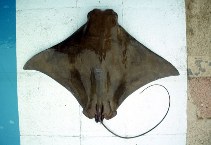
Ikan bertulang rawan (sharks and rays) >
Myliobatiformes (Stingrays) >
Rhinopteridae (Cownose rays)
Etymology: Rhinoptera: Greek, rhinos = nose + Greek,pteron = fin, wing (Ref. 45335).
Eponymy: Franz Steindachner (1834–1919) was an Austrian zoologist who specialised in herpetology and ichthyology. [...] (Ref. 128868), visit book page.
More on authors: Evermann & Jenkins.
Environment: milieu / climate zone / kisaran kedalaman / distribution range
Ekologi
laut berasosiasi dengan karang; oceanodromus (Ref. 51243); kisaran kedalaman 0 - 65 m (Ref. 117244), usually 0 - 25 m. Tropical; 32°N - 5°S, 117°W - 76°W
Eastern Pacific: Gulf of California to Costa Rica and the Galapagos Islands. Probably occurring elsewhere.
Length at first maturity / Size / Weight / umur
Kematangan: Lm 71.0, range 65 - ? cm
Max length : 91.6 cm WD jantan/; (Ref. 116975)
Adults are found over soft bottoms, near rocky or coral reefs; also near reef drop-offs (Ref. 12951). They occasionally swim near the surface and may jump out of the water. Often in schools, sometimes associated with Aetobatus narinari, the spotted eagle ray (Ref. 12951). Adults feed on benthic crustaceans and mollusks. Ovoviviparous (Ref. 50449).
Exhibit ovoviparity (aplacental viviparity), with embryos feeding initially on yolk, then receiving additional nourishment from the mother by indirect absorption of uterine fluid enriched with mucus, fat or protein through specialised structures (Ref. 50449).
McEachran, J.D. and G. Notarbartolo di Sciara, 1995. Rhinopteridae. Gavilanes. p. 782-783. In W. Fischer, F. Krupp, W. Schneider, C. Sommer, K.E. Carpenter and V. Niem (eds.) Guia FAO para Identification de Especies para los Fines de la Pesca. Pacifico Centro-Oriental. 3 Vols. FAO, Rome. (Ref. 9263)
Status IUCN Red List (Ref. 130435: Version 2025-1)
ancaman kepada manusia
Harmless
penggunaan manusia
Perikanan: tidak ada kepentingan; Akuarium: Akuarium publik
Alat, peralatan
laporan khas
muat turun XML
Sumber internet
Estimates based on models
Preferred temperature (Acuan
123201): 19.7 - 29.1, mean 24.2 °C (based on 266 cells).
Phylogenetic diversity index (Acuan
82804): PD
50 = 0.5156 [Uniqueness, from 0.5 = low to 2.0 = high].
Bayesian length-weight: a=0.01148 (0.00463 - 0.02844), b=2.98 (2.76 - 3.20), in cm total length, based on LWR estimates for this (Sub)family-body shape (Ref.
93245).
Trophic level (Acuan
69278): 3.6 ±0.50 se; based on food items.
Generation time: 4.4 ( na - na) years. Estimated as median ln(3)/K based on 1
growth studies.
Daya lenting (Acuan
120179): sangat rendah, Waktu penggandaan populasi minimum lebih dari 14 tahun (k = 0.25; tmax = 10.75; tm = 3.92; Fec = 1).
Fishing Vulnerability (Ref.
59153): Moderate to high vulnerability (50 of 100).
🛈
Nutrients (Ref.
124155): Calcium = 7.27 [0.83, 109.36] mg/100g; Iron = 0.396 [0.033, 4.161] mg/100g; Protein = 20.6 [15.3, 25.9] %; Omega3 = 0.0736 [, ] g/100g; Selenium = 29 [6, 147] μg/100g; VitaminA = 30.9 [2.6, 334.1] μg/100g; Zinc = 0.769 [0.049, 8.696] mg/100g (wet weight);