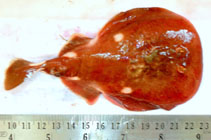
Environment: milieu / climate zone / rango de profundidad / distribution range
Ecología
marino demersal; rango de profundidad 100 - ? m (Ref. 114953). Tropical; 42°N - 0°N, 55°E - 143°E (Ref. 114953)
Indo-West Pacific; Oman (Arabian Sea) to north-east Asia (China and Japan).
Tamaño / Peso / Age
Madurez: Lm ? range ? - ? cm
Max length : 18.0 cm TL macho / no sexado; (Ref. 9913); common length : 20.0 cm TL macho / no sexado; (Ref. 114953)
Found in continental waters, both inshore and offshore (Ref. 9913). Mainly feeds on crustaceans and polychaetes (Ref. 114953). Biology little known (Ref. 9913) but reported to produce 4-6 young each gestation (Ref. 114953). Adult males and females known at 15 cm TL; common size reported to reach 35 cm TL (Ref. 114953). The electric organs present on disc are used to stun the prey.
Life cycle and mating behavior
Madurez | Reproducción | Puesta | Huevos | Fecundidad | Larva
Compagno, L.J.V. and P.R. Last, 1999. Narkidae. Sleeper rays. p. 1443-1446. In K.E. Carpenter and V.H. Niem (eds.) FAO identification guide for fishery purposes. The living marine resources of the Western Central Pacific. FAO, Rome. (Ref. 9913)
IUCN Red List Status (Ref. 130435: Version 2025-1)
Human uses
Pesquerías: escaso valor comercial
Herramientas
Special reports
Download XML
Fuentes de Internet
Estimates based on models
Preferred temperature (Referencia
123201): 19 - 28.2, mean 26.4 °C (based on 992 cells).
Phylogenetic diversity index (Referencia
82804): PD
50 = 0.6252 [Uniqueness, from 0.5 = low to 2.0 = high].
Bayesian length-weight: a=0.01000 (0.00244 - 0.04107), b=3.04 (2.81 - 3.27), in cm total length, based on all LWR estimates for this body shape (Ref.
93245).
Nivel trófico (Referencia
69278): 3.2 ±0.3 se; based on size and trophs of closest relatives
Resiliencia (Referencia
120179): Bajo, población duplicada en un tiempo mínimo de 4.5-14 años (Assuming fecundity<100).
Fishing Vulnerability (Ref.
59153): Low vulnerability (10 of 100).
🛈