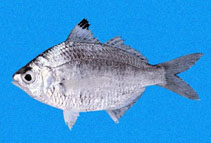
Klassifizierung / Names
Namen | Synonyme | Catalog of Fishes(Gattung, Arten) | ITIS | CoL | WoRMS | Cloffa
>
Eupercaria/misc (Various families in series Eupercaria) >
Gerreidae (Mojarras)
Etymology: Deckertichthys: Named for Gary Dennis Deckert, from the combination of his surname and Latinized Greek, ixhys, ichthys (= fish); gender to be taken as neuter, singular. A tribute to G.D. Deckert.
Eponymy: Dr Gary Dennis Deckert is an American ichthyologist who was Professor at the University of Northern Illinois. [...] (Ref. 128868), visit book page.
More on authors: Jordan & Gilbert.
Environment: milieu / climate zone / Tiefenbereich / distribution range
Ökologie
seewasser benthopelagisch. Tropical; 10°N - 3°S
Eastern Pacific: from Bahía Magdalena (Baja California Sur, Mexico) and off shore in the Gulf of California from Bahía de San Luis Gonzaga (State of Baja California) to Puerto Pizarro, Peru.
Size / Gewicht / Alter
Geschlechtsreife: Lm ? range ? - ? cm
Max length : 15.0 cm SL Männchen/unbestimmt; (Ref. 9303); max. veröff. Gewicht: 53.00 g (Ref. 124487)
There is not much knowledge of the biology of this species, aside from being found in coastal areas, but are very rare in coastal lagoons. It is commonly found in the discarded fauna of shrimp trawls (Ref. 95681).
Life cycle and mating behavior
Geschlechtsreife | Fortpflanzung | Ablaichen | Eier | Fecundity | Larven
Vergara-Solana, F.J., F.J. García-Rodriguez, J.J. Travera, E. De Luna and J. De La Cruz-Agüero, 2014. Molecular and morphometric systematics of Diapterus (Perciformes, Gerreidae). Zool. Scripta (Ref. 95681)
IUCN Rote Liste Status (Ref. 130435: Version 2025-1)
Bedrohung für Menschen
Harmless
Nutzung durch Menschen
Fischereien: kleinfischerei
Tools
Zusatzinformationen
Download XML
Internet Quellen
Estimates based on models
Phylogenetic diversity index (Ref.
82804): PD
50 = 1.0000 [Uniqueness, from 0.5 = low to 2.0 = high].
Bayesian length-weight: a=0.01148 (0.00668 - 0.01973), b=3.03 (2.88 - 3.18), in cm total length, based on LWR estimates for this species & (Sub)family-body (Ref.
93245).
Trophic level (Ref.
69278): 3.7 ±0.7 se; based on diet studies.
Widerstandsfähigkeit (Ref.
120179): hoch, Verdopplung der Population dauert weniger als 15 Monate. (Preliminary K or Fecundity.).
Fishing Vulnerability (Ref.
59153): Low vulnerability (10 of 100).
🛈