Lutjanus bitaeniatus, Indonesian snapper : fisheries

You can sponsor this page

Lutjanus bitaeniatus (Valenciennes, 1830)

Indonesian snapper
Add your observation in Fish Watcher
Native range | All suitable habitat | Point map | Year 2050
This map was computer-generated and has not yet been reviewed.
Lutjanus bitaeniatus   AquaMaps   Data sources: GBIF OBIS
Upload your photos and videos
Imágenes | Google image
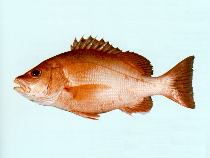
Image of Lutjanus bitaeniatus (Indonesian snapper)
Lutjanus bitaeniatus
Picture by CSIRO

Classification / Names Nombres comunes | Sinónimos | Catalog of Fishes(Género, Especie) | ITIS | CoL | WoRMS | Cloffa

> Eupercaria/misc (Various families in series Eupercaria) > Lutjanidae (Snappers) > Lutjaninae
Etymology: Lutjanus: Malay, ikan lutjan, name of a fish.
More on author: Valenciennes.

Environment: milieu / climate zone / rango de profundidad / distribution range Ecología

marino asociado a arrecife; rango de profundidad 40 - 80 m (Ref. 75154). Tropical; 4°N - 24°S, 91°E - 154°E (Ref. 55)

Distribución Países | Áreas FAO | Ecosistemas | Ocurrencias, apariciones | Mapa de puntos | Introducciones | Faunafri

Eastern Indian Ocean: known only from a few specimens collected at Indonesia (off Sumatra and Sulawesi) and west of Kuri Bay, Western Australia.

Tamaño / Peso / Age

Madurez: Lm ?  range ? - ? cm
Max length : 30.0 cm TL macho / no sexado; (Ref. 55)

Short description Claves de identificación | Morfología | Morfometría

Espinas dorsales (total) : 10; Radios blandos dorsales (total) : 13 - 14; Espinas anales: 3; Radios blandos anales: 8 - 9. Snout somewhat pointed, dorsal profile of head sloping steeply. Preorbital bone relatively narrow, its width usually slightly less than eye diameter. Preopercular notch and knob poorly developed. Scale rows on back rising obliquely above lateral line. Generally red or pink when fresh; fins are red or orange. Juveniles under 10 cm SL have blackish caudal fin lobe tips, frequently also a crescentic blackish blotch in the middle of the caudal fin, sometimes also with a yellowish mid-lateral stripe extending from the rear edge of the operculum to the middle of the caudal fin.
Body shape (shape guide): fusiform / normal; Cross section: oval.

Biología     Glosario (por ej. epibenthic)

Adults inhabit deeper reef areas. They occur solitarily or in small groups.

Life cycle and mating behavior Madurez | Reproducción | Puesta | Huevos | Fecundidad | Larva

Main reference Upload your references | Referencias | Coordinador | Colaboradores

Allen, G.R., 1985. FAO Species Catalogue. Vol. 6. Snappers of the world. An annotated and illustrated catalogue of lutjanid species known to date. FAO Fish. Synop. 125(6):208 p. Rome: FAO. (Ref. 55)

IUCN Red List Status (Ref. 130435: Version 2025-1)

  Least Concern (LC) ; Date assessed: 13 July 2020

CITES

Not Evaluated

CMS (Ref. 116361)

Not Evaluated

Threat to humans

  Harmless


Human uses

Pesquerías: comercial
FAO - Publication: search | FishSource |

Más información

Ecología Trófica
Food items (preys)
Composición de la dieta
consumo de alimento
Food rations
Despredadores
Ecología
Ecología
Home ranges
Population dynamics
Coeficiente del crecimiento para
Max. ages / sizes
Length-weight rel.
Length-length rel.
Length-frequencies
Mass conversion
Reclutamiento
Abundancia
Life cycle
Reproducción
Madurez
Maturity/Gills rel.
Fecundidad
Puesta
Spawning aggregations
Huevos
Egg development
Larva
Dinámica larvaria
Distribución
Países
Áreas FAO
Ecosistemas
Ocurrencias, apariciones
Introducciones
BRUVS - Videos
Anatomy
Superficie branquial
Brain
Otolith
Physiology
Body composition
Nutrients
Consumo del oxígeno
Tipo de natación
Velocidad de natación
Visual pigments
Fish sound
Diseases & Parasites
Toxicity (LC50s)
Genética
Genome
Genética
Heterozygosity
heritabilidad
Human related
Aquaculture systems
Perfiles de acuicultura
Razas
Ciguatera cases
Stamps, coins, misc.
Outreach
Colaboradores
Referencias
Referencias

Herramientas

Special reports

Download XML

Fuentes de Internet

AFORO (otoliths) | Aquatic Commons | BHL | Cloffa | Websites from users | Check FishWatcher | CISTI | Catalog of Fishes: Género, Especie | DiscoverLife | ECOTOX | FAO - Publication: search | Faunafri | Fishipedia | Fishtrace | GloBI | Google Books | Google Scholar | Google | IGFA World Record | OneZoom | Open Tree of Life | Otolith Atlas of Taiwan Fishes | PubMed | Reef Life Survey | Socotra Atlas | TreeBase | Árbol de la vida | Wikipedia: Go, búsqueda | Expediente Zoológico

Estimates based on models

Preferred temperature (Referencia 123201): 25.9 - 27.9, mean 27.3 °C (based on 75 cells).
Phylogenetic diversity index (Referencia 82804):  PD50 = 0.5000   [Uniqueness, from 0.5 = low to 2.0 = high].
Bayesian length-weight: a=0.01479 (0.00706 - 0.03101), b=2.97 (2.80 - 3.14), in cm total length, based on LWR estimates for this Genus-body shape (Ref. 93245).
Nivel trófico (Referencia 69278):  3.8   ±0.7 se; based on size and trophs of closest relatives
Resiliencia (Referencia 120179):  Medio, población duplicada en un tiempo mínimo de 1.4-4.4 años (Preliminary K or Fecundity.).
Fishing Vulnerability (Ref. 59153):  Low vulnerability (20 of 100). 🛈
Price category (Ref. 80766):   High.
Nutrients (Ref. 124155):  Calcium = 46.2 [30.7, 63.9] mg/100g; Iron = 0.374 [0.241, 0.560] mg/100g; Protein = 18.5 [17.0, 19.8] %; Omega3 = 0.151 [0.107, 0.208] g/100g; Selenium = 57.7 [39.0, 82.9] μg/100g; VitaminA = 170 [33, 621] μg/100g; Zinc = 0.486 [0.389, 0.671] mg/100g (wet weight);