>
Anguilliformes (Eels and morays) >
Ophichthidae (Snake eels) > Myrophinae
Etymology: Neenchelys: Name from Greek 'neo' for new and 'enchelys' for eel.
Eponymy: Pieter Buitendijk (1870–1932) was a ship’s surgeon, mainly on steamers trading between Amsterdam and Java. [...] (Ref. 128868), visit book page.
More on authors: Weber & deBeaufort.
Environment: milieu / climate zone / profondeur / distribution range
Écologie
marin démersal; profondeur 2 - 3 m (Ref. 96531). Tropical
Indo-West Pacific: India, Indonesia and western Malaysia. Also reported from Pakistan and Vietnam.
Taille / Poids / Âge
Maturité: Lm ? range ? - ? cm
Max length : 30.0 cm TL mâle / non sexé; (Ref. 7245)
Description synthétique
Clés d'identification | Morphologie | Morphométrie
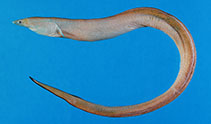
This species is distinguished by the following characters: body robust, its depth 19-32 times in TL; head length (HL) 7.8-8.5 in TL; pointed snout; well developed pectoral fin, which is longer than snout, 4.0-4.8 in HL; origin of dorsal fin relatively forward, 0.4-0.5 times HL behind gill opening; predorsal length 5.7-6.0 in TL; large gill opening, its height 6.8-8.5 in HL; teeth conical, slender, uniserial in jaws and vomer; total vertebrae 135-148; MVF 19-50-140; single median temporal and interorbital pores; supraorbital pores 1 + 4; infraorbital pores 5 + 1 (1 or 2 pores between anterior and posterior nostrils); mandibular pores 7; preopercular pores 2; supratemporal pores 3; cephalic lateral line pores 13 or 14; predorsal pores 20-22; preanal pores 51-54; when preserved specimens are pale brown dorsally and paler ventrally, with black posterior portions of dorsal and anal fins (Ref. 96531).
Body shape (shape guide): eel-like.
A small, burrowing eel which is active over soft sediments at night.
Life cycle and mating behavior
Maturité | Reproduction | Frai | Œufs | Fécondité | Larves
Ho, H.-C., J.E. McCosker and D.G. Smith, 2013. Revision of the worm eel genus Neenchelys (Ophichthidae; Myrophinae), with descriptions of three new species from the western Pacific Ocean. Zoological Studies 52(58):1-20. (Ref. 96531)
Statut dans la liste rouge de l'IUCN (Ref. 130435: Version 2025-1)
Menace pour l'homme
Harmless
Utilisations par l'homme
Pêcheries: intérêt commercial mineur; appât: usually
Outils
Articles particuliers
Télécharger en XML
Sources Internet
Estimates based on models
Preferred temperature (Réf.
123201): 26.5 - 29.1, mean 28.5 °C (based on 1236 cells).
Phylogenetic diversity index (Réf.
82804): PD
50 = 0.5002 [Uniqueness, from 0.5 = low to 2.0 = high].
Bayesian length-weight: a=0.00076 (0.00029 - 0.00197), b=3.06 (2.83 - 3.29), in cm total length, based on LWR estimates for this (Sub)family-body shape (Ref.
93245).
Niveau trophique (Réf.
69278): 4.0 ±0.7 se; based on size and trophs of closest relatives
Résilience (Réf.
120179): Haut, temps minimum de doublement de population inférieur à 15 mois (Preliminary K or Fecundity.).
Fishing Vulnerability (Ref.
59153): Low vulnerability (20 of 100).
🛈