>
Cichliformes (Cichlids, convict blennies) >
Cichlidae (Cichlids) > Pseudocrenilabrinae
Etymology: Oreochromis: Latin, aurum = gold + Greek, chromis = a fish, perhaps a perch (Ref. 45335).
Eponymy: Dr Paul-Victor Schwebisch was a physician who was assistant medical officer on the expedition that collected the type in West Africa. (Ref. 128868), visit book page.
More on author: Sauvage.
Environment: milieu / climate zone / distribuzione batimetrica / distribution range
Ecologia
; acqua dolce benthopelagico. Tropical
Africa: present in the basins of the Ogooué, Nyanga, Kouilou-Niari and Chiloango, Gabon to Democratic Republic of the Congo (Ref. 2, 81260). Reports from Gambia and Senegal (Ref. 3538) and Guinea (4517) are doubtful and need confirmation (see Ref. 2, 81260). Also reported from the Cuanza (Angolan coastal) and the southern Congo River basin in Angola (Ref. 120641) but considered a Lower Guinea endemic in Ref. 81260; needs confirmation.
Size / Peso / Age
Maturità: Lm ? range ? - ? cm
Max length : 30.0 cm SL maschio/sesso non determinato; (Ref. 2)
Short description
Chiavi di identificazione | Morfologia | Morfometria
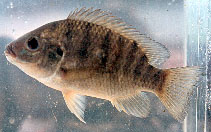
Spine dorsali (totale) : 14 - 16; Raggi dorsali molli (totale) : 12 - 13; Spine anali: 3; Raggi anali molli: 9 - 11; Vertebre: 27 - 29. Diagnosis: scales of cheek in 2 or usually 3 horizontal rows; in mature males preorbital bone and jaws enlarged; upper profile of head often concave; outermost teeth bicuspid, and inner tricuspid in immature fishes and females, all becoming unicuspids in males; male genital papilla spade-shaped; margins of dorsal and caudal fins red in mature males (Ref. 2).
Body shape (shape guide): short and / or deep; Cross section: compressed.
Occasionally territorial; stomachs contained algae, mainly unicellular or in short filaments (Ref. 2). Arena-spawning, exclusively maternal mouthbrooder with marked sexual dichromatism when sexually active (Ref. 81260).
Life cycle and mating behavior
Maturità | Riproduzione | Deposizione | Uova | Fecundity | Larve
Nests are made on sandy or loamy bottoms in water 40-80 cm deep, or more sparsely in depths of a meter or more; they are circular basins with a diameter of 115-185 cm, about 20 cm deep in the middle with a rim raised 7-8 cm above the surrounding level; spawning occurs at night, the fishes seeking deeper waters during the day to avoid high temperatures and intense illumination (Ref. 2). Reproduction is seasonal, usually taking place during the dry seasons from June to September and in February; can reach maturity at a size of 15 cm; breeding behavior is similar to that of its congeners (e.g. O. niloticus) (Ref. 52307).
Trewavas, E., 1983. Tilapiine fishes of the genera Sarotherodon, Oreochromis and Danakilia. British Mus. Nat. Hist., London, UK. 583 p. (Ref. 2)
IUCN Red List Status (Ref. 130435: Version 2025-1)
Threat to humans
Harmless
Human uses
Acquacoltura: probabile utilizzo futuro
Strumenti
Special reports
Download XML
Fonti Internet
Estimates based on models
Phylogenetic diversity index (Fonte Biblio.
82804): PD
50 = 0.5000 [Uniqueness, from 0.5 = low to 2.0 = high].
Bayesian length-weight: a=0.01862 (0.00830 - 0.04177), b=3.01 (2.82 - 3.20), in cm total length, based on LWR estimates for this (Sub)family-body shape (Ref.
93245).
Trophic level (Fonte Biblio.
69278): 2.0 ±0.00 se; based on food items.
Resilienza (Fonte Biblio.
120179): Medio, tempo minimo di raddoppiamento della popolazione 1.4 - 4.4 anni (Preliminary K or Fecundity.).
Fishing Vulnerability (Ref.
59153): Low to moderate vulnerability (27 of 100).
🛈
Nutrients (Ref.
124155): Calcium = 17.8 [7.3, 94.0] mg/100g; Iron = 1.31 [0.55, 3.16] mg/100g; Protein = 17.5 [15.7, 19.4] %; Omega3 = 0.309 [0.111, 0.905] g/100g; Selenium = 80.7 [27.5, 182.4] μg/100g; VitaminA = 14.6 [2.7, 69.2] μg/100g; Zinc = 1.92 [1.01, 4.57] mg/100g (wet weight);