>
Clupeiformes (Herrings) >
Dorosomatidae (Gizzard shads and sardinellas)
Etymology: Tenualosa: Latin, tenuis = thin + Latin, alausa = a fish cited by Ausonius and Latin, halec = pickle, dealing with the Greek word hals = salt; it is also the old Saxon name for shad = "alli" ; 1591 (Ref. 45335).
More on author: Bleeker.
Environment: milieu / climate zone / Mức độ sâu / distribution range
Sinh thái học
Biển; Nước ngọt; Thuộc về nước lợ pelagic-neritic; di cư biển sông (để đẻ trứng) (Ref. 51243); Mức độ sâu 0 - 50 m (Ref. 188). Tropical; 7°N - 9°S, 101°E - 119°E (Ref. 188)
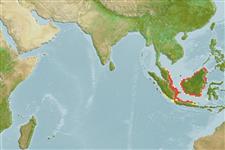
Western Central Pacific: Malaysia, Indonesia (Java Sea and Sarawak, also affluent rivers) and Thailand (southern tip).
Bộ gần gũi / Khối lượng (Trọng lượng) / Age
Chín muồi sinh dục: Lm ? range ? - ? cm
Max length : 52.0 cm SL con đực/không giới tính; (Ref. 188)
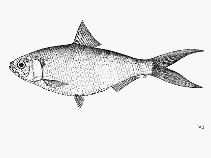
Các tia vây lưng cứng (tổng cộng) : 0; Tia cứng vây hậu môn: 0. Body moderately deep, belly with 30 to 31 scutes. A median notch on upper jaw distinguishes it from other similar clupeids, except Hilsa kelee. Gill rakers fine but not numerous. Caudal fin long, the lobes long and pointed. No series of dark spots along flank. Resembles T. toli, which has longer head but shorter tail; T. reevesii has many more lower gill rakers and a larger head.
Body shape (shape guide): fusiform / normal; Cross section: compressed.
Schooling in coastal waters and ascending rivers to breed. Feeds on zooplankton (Ref. 58784). Presumably its biology is similar to that of T. ilisha, but the fewer gillrakers suggest that it takes larger food organisms. A protandrous hermaphrodite (Ref. 55367).
Life cycle and mating behavior
Chín muồi sinh dục | Sự tái sinh sản | Đẻ trứng | Các trứng | Sự sinh sản | Ấu trùng
A monandric species (Ref. 55367). Sex change occurs at a length of 19.0 cm TL and 0.9 year of age (Ref. 55367).
Whitehead, P.J.P., 1985. FAO Species Catalogue. Vol. 7. Clupeoid fishes of the world (suborder Clupeoidei). An annotated and illustrated catalogue of the herrings, sardines, pilchards, sprats, shads, anchovies and wolf-herrings. FAO Fish. Synop. 125(7/1):1-303. Rome: FAO. (Ref. 188)
IUCN Red List Status (Ref. 130435: Version 2025-1)
Threat to humans
Harmless
Human uses
Các nghề cá: Tính thương mại
Các công cụ
Special reports
Download XML
Các nguồn internet
Estimates based on models
Preferred temperature (Tài liệu tham khảo
123201): 28.2 - 29.1, mean 28.8 °C (based on 266 cells).
Phylogenetic diversity index (Tài liệu tham khảo
82804): PD
50 = 0.5312 [Uniqueness, from 0.5 = low to 2.0 = high].
Bayesian length-weight: a=0.00871 (0.00415 - 0.01826), b=3.06 (2.89 - 3.23), in cm total length, based on LWR estimates for this (Sub)family-body shape (Ref.
93245).
Mức dinh dưỡng (Tài liệu tham khảo
69278): 2.7 ±0.1 se; based on size and trophs of closest relatives
Thích nghi nhanh (Tài liệu tham khảo
120179): Chiêù cao, thời gian nhân đôi của chủng quần tối thiểu là dưới 15 tháng (Assuming fec >10,000).
Fishing Vulnerability (Ref.
59153): Moderate to high vulnerability (45 of 100).
🛈
Nutrients (Ref.
124155): Calcium = 90 [66, 133] mg/100g; Iron = 2.46 [1.40, 4.15] mg/100g; Protein = 17.3 [16.5, 18.2] %; Omega3 = 0.586 [0.280, 1.275] g/100g; Selenium = 45.7 [18.3, 113.8] μg/100g; VitaminA = 14.1 [4.7, 42.9] μg/100g; Zinc = 1.11 [0.70, 1.89] mg/100g (wet weight); based on
nutrient studies.