>
Lampriformes (Velifers, tube-eyes and ribbonfishes) >
Regalecidae (Oarfishes)
Etymology: Agrostichthys: Greek, agros = field, country + Greek, ichthys = fish (Ref. 45335).
Eponymy: Thomas Jeffery Parker (1850–1897) was a British zoologist who graduated from the University of London (1868). [...] (Ref. 128868), visit book page.
Environment: milieu / climate zone / rango de profundidad / distribution range
Ecología
marino pelagic-oceanic. Temperate; 25°S - 59°S (Ref. 92949)
Southern Oceans: collected relatively neaer the surface over or near the continental slope of New Zealand, Australia (with Tasmania), southern Namibia, and Argentina (including Falkland Is or Malvinias.
Tamaño / Peso / Age
Madurez: Lm ? range ? - ? cm
Max length : 300 cm TL macho / no sexado; (Ref. 4171)
Short description
Claves de identificación | Morfología | Morfometría
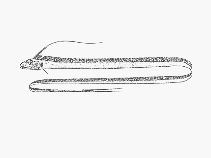
Espinas dorsales (total) : 2 - 7; Espinas anales: 0; Radios blandos anales: 0. Distinguished in having just 6 to 9 gill rakers on the first gill arch, 8 to 11 pectoral fin rays, and just 2 caudal fin rays. Start of the dorsal fin having 1 to 3 simple elongated rays, apparently never ornamented; not forming a single or double crest but are membranously joined to each other as well as to the dorsal fin. No cristophore. Head is shallow, with gently sloping snout. (Ref. 92949). Body silvery in color. Dorsal fin rose-colored and with more than 400 soft rays (Ref. 4171). Opercular bones well-developed. Small, protrusible mouth, without visible teeth; premaxilla extending forward along dorsal profile of head; axis of maxilla oblique. Skin of fragmented body naked, studded with numerous hard tubercles. Lateral line runs along sides consisting of a chain of oblong plates to form a continuous tube (Ref. 43600).
Body shape (shape guide): eel-like.
Rare species, known from only seven specimens. Occurs in the open ocean habitat (Ref. 4171). Found only in the southern oceans from 25°S to 59°S. Apparently also capable of autotomy, unique amongst lampridiforms. Early life history stages (eggs and larvae) unknown. Predators, prey, and parasites unknown (Ref. 92949).
Life cycle and mating behavior
Madurez | Reproducción | Puesta | Huevos | Fecundidad | Larva
Heemstra, P.C., 1986. Regalecidae. p. 403. In M.M. Smith and P.C. Heemstra (eds.) Smiths' sea fishes. Springer-Verlag, Berlin. (Ref. 4171)
IUCN Red List Status (Ref. 130435: Version 2025-1)
Threat to humans
Harmless
Human uses
Pesquerías: sin interés
Herramientas
Special reports
Download XML
Fuentes de Internet
Estimates based on models
Preferred temperature (Referencia
123201): 6.4 - 13.4, mean 9.5 °C (based on 127 cells).
Phylogenetic diversity index (Referencia
82804): PD
50 = 1.1250 [Uniqueness, from 0.5 = low to 2.0 = high].
Bayesian length-weight: a=0.00102 (0.00046 - 0.00225), b=3.06 (2.88 - 3.24), in cm total length, based on all LWR estimates for this body shape (Ref.
93245).
Nivel trófico (Referencia
69278): 3.4 ±0.5 se; based on size and trophs of closest relatives
Fishing Vulnerability (Ref.
59153): Very high vulnerability (90 of 100).
🛈