>
Lophiiformes (Anglerfishes) >
Oneirodidae (Dreamers)
Etymology: Microlophichthys: Greek, 'mikros' = small + Greek, 'lophos' = crest or tuft + Greek, 'ichtys' = fish (put together, alludes to this "fish with a tiny lure") (Ref. 86949).
More on author: Regan.
Environment: milieu / climate zone / rango de profundidad / distribution range
Ecología
marino batipelágico; rango de profundidad 800 - 2200 m (Ref. 86949). Deep-water
Tropical and subtropical parts of all oceans.
Tamaño / Peso / Age
Madurez: Lm ? range ? - ? cm
Max length : 11.8 cm TL (female)
Short description
Claves de identificación | Morfología | Morfometría
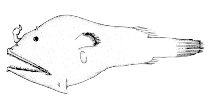
Radios blandos dorsales (total) : 5 - 7; Radios blandos anales: 4 - 6. Metamorphosed females distinguished by the following characteristics: wide ethmoid cartilage and vomer, wider than distance between anterolateral tips of lateral ethmoids and frontals; presence of vomerine teeth; large and nearly circular nasal foramina; frontals short, lying posterior to the ethmoid region, dorsal margin convex; ventromedial extensions of frontals approach each other on midline, making contact with parasphenoid; frontals separated from prootics; presence of pterosphenoid; anterior end of illicial trough wider and shallower than posterior end; well developed sphenotic spines; symphysial cartilage of upper jaw longer than wide; lower jaw with well developed symphisial spine; hyomandibula with double head; well developed quadrate spine, longer than articular spine; deeply notched posterior margin of opercle; short and broad subopercle, dorsal end rounded or tapering to a blunt point, ventral end nearly circular; first pharyngobranchial reduced to a tiny remnant; absence of second hypobranchial; caudal fin rays without internal pigmentation; extremely short illicium, approximately equal to length of escal bulb; pterygiophore of illicium cylindrical throughout, emerging on snout from between frontal bones, anterior end barely exposed, posterior end concealed beneath the skin; first ray of dorsal fin well developed; dorsal fin rays 5-7; anal fin rays 4-6; short and broad pectoral fin lobe, shorter than longest rays of pectoral fin; pectoral fin rays 18-20; coracoid lacking posteroventral process; simple pelvic bones, with or without distal expansion; skin smooth and naked, without dermal spinules; darkly pigmented skin of caudal peduncle extends well past base of caudal fin (Ref. 86949).
Also mesopelagic (Ref. 10524).
Life cycle and mating behavior
Madurez | Reproducción | Puesta | Huevos | Fecundidad | Larva
Bertelsen, E., 1990. Oneirodidae. p. 498-507. In J.C. Quero, J.C. Hureau, C. Karrer, A. Post, and L. Saldanha (eds.) Check-list of the fishes of the eastern tropical Atlantic (CLOFETA). JNICT, Lisbon; SEI, Paris; and UNESCO, Paris. Vol. 1. (Ref. 10524)
IUCN Red List Status (Ref. 130435: Version 2025-1)
Threat to humans
Harmless
Human uses
Herramientas
Special reports
Download XML
Fuentes de Internet
Estimates based on models
Preferred temperature (Referencia
123201): 2.4 - 5, mean 3.8 °C (based on 313 cells).
Phylogenetic diversity index (Referencia
82804): PD
50 = 0.7500 [Uniqueness, from 0.5 = low to 2.0 = high].
Bayesian length-weight: a=0.01000 (0.00244 - 0.04107), b=3.04 (2.81 - 3.27), in cm total length, based on all LWR estimates for this body shape (Ref.
93245).
Nivel trófico (Referencia
69278): 3.7 ±0.5 se; based on size and trophs of closest relatives
Resiliencia (Referencia
120179): Medio, población duplicada en un tiempo mínimo de 1.4-4.4 años (Fecundity assumed < 1000).
Fishing Vulnerability (Ref.
59153): Low vulnerability (10 of 100).
🛈