>
Holocentriformes (Squirrelfishes, soldierfishes) >
Holocentridae (Squirrelfishes, soldierfishes) > Myripristinae
Etymology: Myripristis: Greek, myros, -ou = male of morey eel + Greek, pristis = saw (Ref. 45335).
Eponymy: Loren P Woods (1914–1979) was Curator, Department of Ichthyology (1941–1978), Field Museum of Natural History, Chicago, where he worked (1938–1978), broken only by service in WW2 in the US Navy (1943–1946). [...] (Ref. 128868), visit book page.
More on author: Greenfield.
Environment: milieu / climate zone / intervalo de profundidade / distribution range
Ecologia
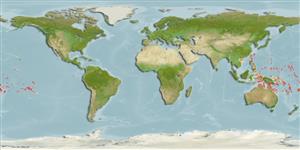
marinhas associadas(os) a recifes; intervalo de profundidade 2 - 20 m (Ref. 86942). Tropical; 26°N - 24°S
Pacific Ocean: islands of Oceania except Hawaii, Easter Island, Pitcairn Group or islands off the Plate such as Solomon Islands and New Caledonia. Also Caroline Islands to the Line Islands (Kiribati); north to Bonin and Marcus Islands; south to Samoa and Tuamoto Islands, including Micronesia (Ref. 1602).
Tamanho / Peso / Idade
Maturidade: Lm ? range ? - ? cm
Max length : 26.5 cm TL macho/indeterminado; (Ref. 89972)
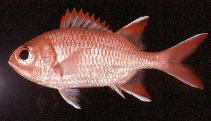
Espinhos dorsais (total) : 11; Raios dorsais moles (total) : 13 - 14; Espinhos anais: 4; Raios anais moles: 10 - 13. This species is the only Micronesian large-scaled Myripristis that lacks scales on its inner pectoral axil. It also differs by having a white spot on the upper inner pectoral axil and combination of dark red (versus black) opercular membrane, dark red or purple pectoral axil, distinct white ring around the iris, an white anterior margins of its pelvic an soft rayed fins.
Body shape (shape guide): fusiform / normal; Cross section: compressed.
Inhabits reef flats, lagoons, and seaward reefs (Ref. 9710). Commonly found on exposed outer-reef areas; often at low islands and atolls than high islands (Ref. 12419). Feeds on zooplanktons (Ref. 89972).
Life cycle and mating behavior
Maturidade | Reprodução | Desova | Ovos | Fecundidade | Larvas
Randall, J.E. and D.W. Greenfield, 1996. Revision of the Indo-Pacific holocentrid fishes of the genus Myripristis, with descriptions of three new species. Indo-Pac. Fish. (25):61 p. (Ref. 12419)
Categoria na Lista Vermelha da IUCN (Ref. 130435: Version 2025-1)
Ameaça para o homem
Harmless
Utilização humana
Pescarias: espécies comerciais
Ferramentas
Relatórios especiais
Descarregue XML
Fontes da internet
Estimates based on models
Preferred temperature (Ref.
123201): 25.7 - 29.4, mean 28.3 °C (based on 1027 cells).
Phylogenetic diversity index (Ref.
82804): PD
50 = 0.5000 [Uniqueness, from 0.5 = low to 2.0 = high].
Bayesian length-weight: a=0.02512 (0.01502 - 0.04202), b=2.97 (2.83 - 3.11), in cm total length, based on LWR estimates for this species & Genus-body shape (Ref.
93245).
Nível Trófico (Ref.
69278): 3.5 ±0.5 se; based on size and trophs of closest relatives
Resiliência (Ref.
120179): Elevada, tempo mínimo de duplicação da população menor que 15 meses (Preliminary K or Fecundity.).
Fishing Vulnerability (Ref.
59153): Low vulnerability (17 of 100).
🛈
Nutrients (Ref.
124155): Calcium = 67.2 [30.9, 196.3] mg/100g; Iron = 0.703 [0.290, 1.430] mg/100g; Protein = 18.6 [17.5, 19.8] %; Omega3 = 0.148 [0.061, 0.337] g/100g; Selenium = 28.7 [17.0, 52.4] μg/100g; VitaminA = 72 [27, 188] μg/100g; Zinc = 1.36 [0.89, 2.08] mg/100g (wet weight);