



Epinephelus striatus (Bloch, 1792)
Nassau grouper
Ajouter votre observation dans Fish Watcher
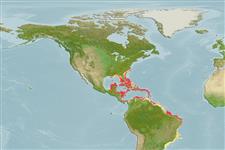
| Native range | All suitable habitat | Point map | Year 2050 |
|
| This map was computer-generated and has not yet been reviewed. |
| Epinephelus striatus AquaMaps Data sources: GBIF OBIS |
Envoyez vos Photos et vidéos
Images | vidéos | Sons | Timbres, pièces de monnaie, divers | Images Google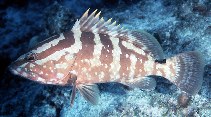 Epinephelus striatus
Photo de Randall, J.E.
Images | vidéos | Sons | Timbres, pièces de monnaie, divers | Images Google
Photo de Randall, J.E.
Classification / Noms Noms communs | Synonymes | Catalog of Fishes(Genre, Espèce) | ITIS | CoL | WoRMS | Cloffa
> Perciformes/Serranoidei (Groupers) > Epinephelidae (Groupers)
Etymology: Epinephelus: Greek, epinephelos = cloudy (Ref. 45335).
More on author: Bloch.
Etymology: Epinephelus: Greek, epinephelos = cloudy (Ref. 45335).
More on author: Bloch.
Environnement : milieu / zone climatique / profondeur / gamme de distribution Écologie
marin récifal; océanodrome (Ref. 51243); profondeur 1 - 90 m (Ref. 5217). Tropical; 35°N - 34°S, 92°W - 34°W (Ref. 5222)
Distribution Territoires | Zones FAO | Écosystèmes | Occurrences | Carte par point | Introductions | Faunafri
Western Atlantic: Bermuda, Florida, Bahamas, Yucatan Peninsula and throughout the Caribbean to southern Brazil. Not known from the Gulf of Mexico except at the Campeche Bank off the coast of Yucatan, at Tortugas and off Key West.
Longueur à la première maturité / Taille / Poids / Âge
Maturité: Lm 48.0 range ? - ? cm
Max length : 122 cm TL mâle / non sexé; (Ref. 5227); poids max. publié: 25.0 kg (Ref. 5222); âge max. reporté: 29 années (Ref. 45400)
Max length : 122 cm TL mâle / non sexé; (Ref. 5227); poids max. publié: 25.0 kg (Ref. 5222); âge max. reporté: 29 années (Ref. 45400)
Description synthétique Clés d'identification | Morphologie | Morphométrie
Épines dorsales (Total) : 11 - 12; Rayons mous dorsaux (Total) : 16 - 18; Épines anales: 3; Rayons mous anaux: 8. Caudal fin rounded in juveniles. Dorsal fin notched between forward spines; 3rd or 4th spine the longest. Bases of soft dorsal and anal fins covered with scales and thick skin; scales small and greatly overlapping. Ground color tawny in individuals in shallow water, shading to pinkish or red in those from deeper water, sometimes with an orange cast. Can change color pattern in a few minutes from almost white to uniformly dark brown depending on mood. Third and fourth vertical bars branch above lateral line forming a W-shaped mark. Several distinct black spots below and behind eye and a characteristic `tuning-fork shaped stripe on top of head, dividing just behind the orbits. (see also Refs. 5221, 5222, 5227 and 2458).
Body shape (shape guide): fusiform / normal; Cross section: compressed.
Body shape (shape guide): fusiform / normal; Cross section: compressed.
Occurs from the shoreline to at least 90 m depth. Usually close to caves (Ref. 9710). Juveniles are common in seagrass beds. Diet comprises mainly of fishes (54%) and crabs (23%) and lesser amounts of other crustaceans and mollusks. It is solitary and mainly diurnal; but may sometimes form schools. Spawns near the new moon with up to 30,000 aggregating at certain spawning sites (Ref. 9710). The least wary and most friendly of all the groupers (Ref. 5226). Heavily fished and vulnerable to overfishing, particularly when migrating or aggregating to spawn (Ref. 9710). The most important commercial grouper in the West Indies. Marketed fresh, mostly between 2 to 10 kg (Ref. 3708).
Cycle de vie et comportement reproducteur Maturité | Reproduction | Frai | Œufs | Fécondité | Larves
Most males and females display a bicolored pattern during spawning. Courtship behavior involves vertical spiral movement, short vertical runs followed by rapid aggregation then rapid dispersal and horizontal runs near the bottom. Sex reversal reportedly between 30 and 80 cm SL. Some primary males found recently (Ref. 5222). Protogyny was assumed in old literature, but dioecism (gonochorism) has been demonstrated. Pelagic spawner (Ref. 31572).
Référence principale
Téléchargez vos références | Références | Coordinateur | Collaborateurs
Heemstra, P.C. and J.E. Randall, 1993. FAO Species Catalogue. Vol. 16. Groupers of the world (family Serranidae, subfamily Epinephelinae). An annotated and illustrated catalogue of the grouper, rockcod, hind, coral grouper and lyretail species known to date. Rome: FAO. FAO Fish. Synop. 125(16):382 p. (Ref. 5222)
Statut dans la liste rouge de l'IUCN (Ref. 130435: Version 2025-2 (Global))
Niveau de menace critique (CR) (A4bd); Date assessed: 18 November 2016
CITES
Not Evaluated
Menace pour l'homme
Reports of ciguatera poisoning (Ref. 30303)
Utilisations par l'homme
Pêcheries: commercial; pêche sportive: oui; Aquarium: Aquariums publics
FAO - pêcheries: débarquements; Publication: search | FishSource | Sea Around Us
Plus d'informations
Écologie trophique
Aliments (proies)
Composition du régime alimentaire
Consommation alimentaire
Rations alimentaires
Prédateurs
Aliments (proies)
Composition du régime alimentaire
Consommation alimentaire
Rations alimentaires
Prédateurs
Dynamique des populations
Paramètres de croissance
Âges / tailles maximales
Longueur-poids rel.
Rel. longueur-longueur.
Fréquences de longueurs
Conversion de masse
Recrutement
Abondance
Paramètres de croissance
Âges / tailles maximales
Longueur-poids rel.
Rel. longueur-longueur.
Fréquences de longueurs
Conversion de masse
Recrutement
Abondance
Cycle de vie
Reproduction
Maturité
Maturité/épines rel.
Fécondité
Frai
Agrégats de frai
Œufs
Développement de l'œuf
Larves
Dynamique des populations larvaires
Reproduction
Maturité
Maturité/épines rel.
Fécondité
Frai
Agrégats de frai
Œufs
Développement de l'œuf
Larves
Dynamique des populations larvaires
Anatomie
Surface branchiale
Cerveau
Otolithe
Surface branchiale
Cerveau
Otolithe
Physiologie
Composition corporelle
Nutriments
Consommation d'oxygène
Type de natation
Vitesse de nage
Pigments visuels
Son de poisson
Maladies et parasites
Toxicité (CL50)
Composition corporelle
Nutriments
Consommation d'oxygène
Type de natation
Vitesse de nage
Pigments visuels
Son de poisson
Maladies et parasites
Toxicité (CL50)
Liées à l'homme
Systèmes d'aquaculture
Profils d'aquaculture
Souches
Cas de ciguatera
Timbres, pièces de monnaie, divers
Systèmes d'aquaculture
Profils d'aquaculture
Souches
Cas de ciguatera
Timbres, pièces de monnaie, divers
Outils
Quiz bio | E-book | Guide de terrain | Clés d'identification | Générateur de fréquences de longueur | Outil de dynamique de population | Carte par point |
Capture-MSY |
Articles particuliers
Télécharger en XML
Sources Internet
AFORO (otoliths) | Aquatic Commons | BHL | Cloffa | Websites from users | FishWatcher | CISTI | Catalog of Fishes: Genre, Espèce | DiscoverLife | DORIS | ECOTOX | FAO - pêcheries: débarquements; Publication: search | Faunafri | Fishipedia | Fishtrace | GloBI | Google Books | Google Scholar | Google | IGFA World Record | Bases de données nationales | OneZoom | Open Tree of Life | Otolith Atlas of Taiwan Fishes | Aquariums publics | PubMed | Reef Life Survey | Socotra Atlas | TreeBase | Arbre de Vie | Wikipedia: aller à, chercher | World Records Freshwater Fishing | Zoological Record
Estimations basées sur des modèles
Température préférée (Réf. 123201): 22.8 - 28, mean 26.4 °C (based on 400 cells).
Indice de diversité phylogénétique (Réf. 82804): PD50 = 0.5000 [Uniqueness, from 0.5 = low to 2.0 = high].
Bayesian length-weight: a=0.01148 (0.01001 - 0.01316), b=3.05 (3.03 - 3.07), in cm total length, based on LWR estimates for this species (Ref. 93245).
Niveau trophique (Réf. 69278): 4.1 ±0.0 se; based on diet studies.
Résilience (Réf. 120179): Faible, temps minimum de doublement de population : 4,5 à 14 années (Musick et al. 2000 (Ref. 36717)).
Prior r = 0.43, 95% CL = 0.28 - 0.64, Based on 1 data-limited stock assessment.
Nutriments (Ref. 124155): Calcium = 15.2 [7.2, 34.8] mg/100g; Iron = 0.444 [0.224, 0.890] mg/100g; Protein = 18.4 [16.8, 19.9] %; Omega3 = 0.106 [0.063, 0.178] g/100g; Selenium = 46.3 [23.9, 93.4] μg/100g; VitaminA = 201 [51, 791] μg/100g; Zinc = 0.995 [0.670, 1.432] mg/100g (wet weight);