>
Eupercaria/misc (Various families in series Eupercaria) >
Lethrinidae (Emperors or scavengers) > Lethrininae
Etymology: Lethrinus: Greek, lethrinia, a fish pertaining to genus Pagellus.
More on author: Smith.
Environment: milieu / climate zone / intervalo de profundidade / distribution range
Ecologia
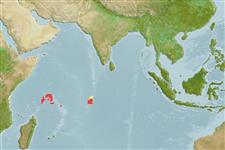
marinhas associadas(os) a recifes; não migratória; intervalo de profundidade ? - 50 m. Tropical; 3°S - 9°S
Western Indian Ocean: known only from the Seychelles. Has been synonymized with Lethrinus mahsena.
Length at first maturity / Tamanho / Peso / Idade
Maturidade: Lm 25.0 range ? - ? cm
Max length : 55.0 cm TL macho/indeterminado; (Ref. 2295); common length : 32.5 cm TL macho/indeterminado; (Ref. 2295)
Descrição breve
Chaves de identificação | Morfologia | Morfometria
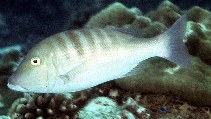
Espinhos dorsais (total) : 10; Raios dorsais moles (total) : 9; Espinhos anais: 3; Raios anais moles: 8. Body is yellowish bronze or gray, becoming lighter ventrally. Sometimes three bronze stripes are on the upper side. The head is gray, brown or sometimes bronze with a series of yellowish cross stripes on the upper portion of the head and snout. A light streak radiates from the eye to the anterior nostril. the lower edge of the orbit has dark purplish spots. The maxilla is reddish. The fins are pale, yellowish or bronze.
Body shape (shape guide): fusiform / normal; Cross section: oval.
Found over seagrass beds, coral reefs and adjacent sandy areas. Feeds mainly on echinoderms, crustaceans, and fish, and to a lesser degree on mollusks. Smaller, more numerous females than males have been confirmed for the Saya de Malta population (Ref. 2295). Marketed fresh (Ref. 171).
Life cycle and mating behavior
Maturidade | Reprodução | Desova | Ovos | Fecundidade | Larvas
Carpenter, K.E. and G.R. Allen, 1989. FAO Species Catalogue. Vol. 9. Emperor fishes and large-eye breams of the world (family Lethrinidae). An annotated and illustrated catalogue of lethrinid species known to date. FAO Fish. Synop. 125(9):118 p. Rome: FAO. (Ref. 2295)
Categoria na Lista Vermelha da IUCN (Ref. 130435: Version 2025-1)
Ameaça para o homem
Harmless
Utilização humana
Pescarias: espécies comerciais
Ferramentas
Relatórios especiais
Descarregue XML
Fontes da internet
Estimates based on models
Preferred temperature (Ref.
123201): 25.8 - 28.2, mean 27.6 °C (based on 10 cells).
Phylogenetic diversity index (Ref.
82804): PD
50 = 0.5000 [Uniqueness, from 0.5 = low to 2.0 = high].
Bayesian length-weight: a=0.01445 (0.00738 - 0.02832), b=2.99 (2.83 - 3.15), in cm total length, based on LWR estimates for this species & Genus-body shape (Ref.
93245).
Nível Trófico (Ref.
69278): 3.8 ±0.58 se; based on food items.
Resiliência (Ref.
120179): Baixo, tempo mínimo de duplicação da população 4,5 - 14 anos (K=0.13-0.18).
Fishing Vulnerability (Ref.
59153): Moderate to high vulnerability (54 of 100).
🛈
Nutrients (Ref.
124155): Calcium = 36.1 [26.0, 48.7] mg/100g; Iron = 0.737 [0.501, 1.016] mg/100g; Protein = 20.1 [17.5, 22.3] %; Omega3 = 0.122 [0.090, 0.163] g/100g; Selenium = 41 [21, 60] μg/100g; VitaminA = 36.5 [7.9, 195.4] μg/100g; Zinc = 2.12 [1.66, 2.64] mg/100g (wet weight); based on
nutrient studies.