This website uses cookies to enhance your browsing experience and ensure the functionality of our site. For more detailed information about the types of cookies we use and how we protect your privacy, please visit our Privacy Information page.
×
Cookie Settings
This website uses different types of cookies to enhance your experience. Please select your preferences below:
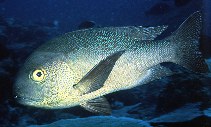
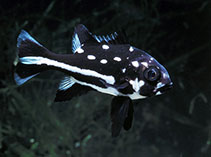
Rückenflossenstacheln (insgesamt) : 10; Rückenflossenweichstrahlen (insgesamt) : 13 - 14; Afterflossenstacheln: 3; Afterflossenweichstrahlen: 10. This species is distinguished by the following characters: body relatively deep and laterally compressed, greatest body depth 2.2-2.4 in SL; dorsal profile of head convex in adults, in oblique straight line in young; maxilla without scales or longitudinal ridges; preopercle with a deep notch (or gash) receiving elongate interopercular spine (for individuals of about 20 cm SL); gill rakers of first gill arch 37-42 + 71-81 = 110-122; soft rays of dorsal fin usually 13; continuous dorsal fin with spinous portion distinctly notched in young; dorsal and anal fins distinctly pointed posteriorly, the soft ray of both fins, shorter than next to last ray; caudal fin rounded (individuals < 20 cm SL) and emarginate (individuals >10 cm SL); pelvic fins very long and pointed in young, but short and rounded in adults; soft dorsal and anal fins with scales basally; tubed lateral-line scales 50-55; juveniles with very long pelvic fins. Colour of adults dark grey brown dorsally and shading to yellow on head and ventral body, head with fine blue lines or spots, body scales with blue lines or short dashes, smaller adult with trace or juvenile pattern especially the white spots; juveniles with distinct black and white pattern, with more than 5 white spots on back; subadult similar to juvenile but with white spots on back more numerous and black areas with small white spots (Ref 9821, 90102). Body shape (shape guide): short and / or deep; Cross section: compressed.
Adults inhabit steep slopes of lagoon, channel, or seaward reefs (Ref. 9710), commonly on deep reef slopes and may be in small groups (Ref. 9710, 48635). Juveniles occur singly on protected reef slopes with feather stars, in staghorn corals or large sponges. Occasionally, they aggregate with M. niger. Apparently feed primarily on large zooplankton at night (Ref. 37816); but also feed largely on fishes and crustaceans. Caught with handlines, gill nets, and traps, also speared by divers. Usually seen in markets and sold mainly fresh (Ref. 9821). Minimum depth reported taken from Ref. 128797.
Allen, G.R., 1985. FAO Species Catalogue. Vol. 6. Snappers of the world. An annotated and illustrated catalogue of lutjanid species known to date. FAO Fish. Synop. 125(6):208 p. Rome: FAO. (Ref. 55)
IUCN Rote Liste Status (Ref. 130435: Version 2025-2 (Global))
Bevorzugte Temperatur (Ref. 123201): 26.1 - 29, mean 28 °C (based on 946 cells).
Phylogenetischer Diversitätsindex (Ref. 82804): PD50 = 0.7500 [Uniqueness, from 0.5 = low to 2.0 = high].
Bayesian length-weight: a=0.01660 (0.00936 - 0.02944), b=2.97 (2.80 - 3.14), in cm total length, based on LWR estimates for this species & (Sub)family-body (Ref. 93245).
Trophische Ebene (Ref. 69278): 4.0 ±0.65 se; based on food items.
Widerstandsfähigkeit (Ref. 120179): mittel, Verdopplung der Population dauert 1,4 - 4,4 Jahre. (Preliminary K or Fecundity.).
Anfälligkeit der Fischerei (Ref. 59153): Moderate vulnerability (44 of 100). 🛈