>
Carangiformes (Jacks) >
Carangidae (Jacks and pompanos) > Caranginae
Etymology: Caranx: French, carangue, the name of a Caribbean fish; 1836 (Ref. 45335).
More on author: Günther.
Environment: milieu / Klimaatzone / Diepte / distribution range
Ecologie
marien; brak water pelagic-oceanic; oceanodroom (Ref. 51243); diepte 1 - 350 m (Ref. 9283). Subtropical; 33°N - 7°S, 119°W - 76°W
Eastern Pacific: San Diego, California, USA to Peru, including the Gulf of California and the Galapagos Islands. Probably the same species as Caranx hippos in the Atlantic.
Grootte / Gewicht / Leeftijd
Maturiteit: Lm ? range ? - ? cm
Max length : 101 cm FL mannelijk / geslacht onbekend; (Ref. 40637); common length : 60.0 cm TL mannelijk / geslacht onbekend; (Ref. 9283); max. gepubliceerd gewicht: 17.7 kg (Ref. 40637); max. gerapporteerde leeftijd: 15 Jaren (Ref. 98594)
Korte beschrijving
Determinatiesleutels | Morfologie | Morfometrie
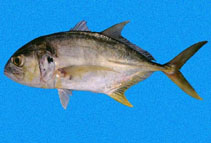
Body deep, elongated and slightly compressed; eye with an adipose eyelid; posterior edge of lower jaw behind posterior edge of eye; chest mostly scaleless, just a small patch in front of pectoral fins; 35 to 42 strong scutes; back of body blue to blue black; belly white, silvery, or yellow; pectoral fins and operculum each with a black spot (Ref. 55763).
Body shape (shape guide): fusiform / normal.
Adults occur in oceanic and coastal waters, commonly found in shallow water, with larger individuals up to 350 m depth (Ref. 9283). Also found in brackish water and occasionally ascend rivers (Ref. 9283). They form medium-sized to big schools, but large adults may be solitary (Ref. 9283). They feed mainly on fishes, but also takes shrimps and other invertebrates (Ref. 9283). Often makes a grunting sound when captured (Ref. 9283). Juveniles are often found in river estuaries (Ref. 9283). Marketed fresh, frozen, smoked and salted or dried; also utilized as fishmeal and a source of oil (Ref. 9283).
Levenscyclus en paargedrag
Maturiteit | Voortplanting | Paaien | Eieren | Fecunditeit | Larven
Eschmeyer, W.N., E.S. Herald and H. Hammann, 1983. A field guide to Pacific coast fishes of North America. Boston (MA, USA): Houghton Mifflin Company. xii+336 p. (Ref. 2850)
Status op de Rode Lijst van het IUCN (Ref. 130435: Version 2025-1)
Gevaar voor de mens
Harmless
Gebruik door de mens
Visserij: commercieel; sportvis: ja
Tools
Speciale rapporten
Download XML
Internetbronnen
Estimates based on models
Preferred temperature (Ref.
123201): 12.9 - 21.7, mean 15.7 °C (based on 68 cells).
Fylogenetische diversiteitsindex (Ref.
82804): PD
50 = 0.5000 [Uniqueness, from 0.5 = low to 2.0 = high].
Bayesian length-weight: a=0.01479 (0.00938 - 0.02333), b=2.95 (2.83 - 3.07), in cm total length, based on LWR estimates for this species & Genus-body shape (Ref.
93245).
Trofisch niveau (Ref.
69278): 3.9 ±0.61 se; based on food items.
Generation time: 5.4 ( na - na) years. Estimated as median ln(3)/K based on 2
growth studies.
Weerstandsvermogen (Ref.
120179): Gemiddeld, minimale populatieverdubbelingstijd 1,4-4,4 jaar (Preliminary K or Fecundity.).
Fishing Vulnerability (Ref.
59153): Moderate to high vulnerability (47 of 100).
🛈
Nutrients (Ref.
124155): Calcium = 28.6 [11.4, 60.7] mg/100g; Iron = 0.665 [0.328, 1.382] mg/100g; Protein = 20.4 [18.1, 22.9] %; Omega3 = 0.388 [0.210, 0.722] g/100g; Selenium = 35.6 [15.3, 84.4] μg/100g; VitaminA = 7.38 [2.23, 21.63] μg/100g; Zinc = 0.416 [0.252, 0.668] mg/100g (wet weight);