



Caranx sexfasciatus Quoy & Gaimard, 1825
Bigeye trevally
Waarneming toevoegen in Fish Watcher
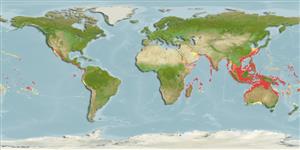
| Native range | All suitable habitat | Point map | Year 2050 |
|
| This map was computer-generated and has not yet been reviewed. |
| Caranx sexfasciatus AquaMaps Data sources: GBIF OBIS |
Uploaden van uw Foto's en video's
Afbeeldingen | video's | Google afbeelding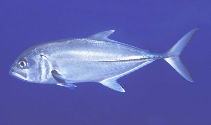 Caranx sexfasciatus
Afbeelding van Patzner, R.
Afbeeldingen | video's | Google afbeelding
Afbeelding van Patzner, R.
Classificatie / Namen Lokale namen | Synoniemen | Catalog of Fishes(Genus, Soort(en)) | ITIS | CoL | WoRMS | Cloffa
> Carangiformes (Jacks) > Carangidae (Jacks and pompanos) > Caranginae
Etymology: Caranx: French, carangue, the name of a Caribbean fish; 1836 (Ref. 45335).
More on authors: Quoy & Gaimard.
Etymology: Caranx: French, carangue, the name of a Caribbean fish; 1836 (Ref. 45335).
More on authors: Quoy & Gaimard.
Milieu: milieu / Klimaatzone / Diepte / verspreidingsgebied Ecologie
marien; zoet water; brak water rifbewoner; amfidroom; diepte 0 - 146 m (Ref. 57178). Tropical; 26°C - 29°C; 32°N - 36°S, 25°E - 77°W
Verspreiding Gebieden | FAO regio's | Ecosystemen | Voorkomen | Verspreidingskaart | Introducties | Faunafri
Indo-Pacific: Red Sea and East Africa to Hawaii, north to southern Japan and the Ogasawara Islands, south to Australia and New Caledonia. Eastern Pacific: southwestern coast of Baja California Sur, Mexico and the Gulf of California to Ecuador and the Galapagos Islands (Ref. 9283).
Lengte bij maturiteit / Grootte / Gewicht / Leeftijd
Maturiteit: Lm 42.0 range ? - ? cm
Max length : 120 cm TL mannelijk / geslacht onbekend; (Ref. 9987); common length : 60.0 cm FL mannelijk / geslacht onbekend; (Ref. 3287); max. gepubliceerd gewicht: 18.0 kg (Ref. 9987); max. gerapporteerde leeftijd: 11 Jaren (Ref. 82366)
Max length : 120 cm TL mannelijk / geslacht onbekend; (Ref. 9987); common length : 60.0 cm FL mannelijk / geslacht onbekend; (Ref. 3287); max. gepubliceerd gewicht: 18.0 kg (Ref. 9987); max. gerapporteerde leeftijd: 11 Jaren (Ref. 82366)
Korte beschrijving Determinatiesleutels | Morfologie | Morfometrie
Dorsale stekels (totaal) : 9; Dorsale zachte stralen (totaal) : 19 - 22; Anale stekels: 3; Anale zachte stralen: 14 - 17; Wervels: 25. This species is distinguished by the following characters: dorsal profile moderately convex anteriorly; adipose eyelid well developed, moderate anteriorly, posterior eyelid extends onto eye to rear border of pupil; gill rakers (including rudiments) 6-8 + 15-19 = 21-25; straight part of lateral line with 0-3 anterior scales followed by 27-36 strong, dark scutes; breast completely scaly; vertebrae 10+15; upper jaw with outer row of strong canines widely spaced in adults, and an inner band of small villiform teeth, widest at symphysis; on lower limb of first gill arch jaw with a single row of strong conical teeth widely spaced in adults. Colour in life with adults' head and body silvery olive to iridescent blue-green above, silvery olive to whitish below; small blackish spot, much smaller than pupil diameter, at upper angle of opercle (this spot evident on specimens of about 14 cm fork length); second dorsal fin olive to blackish, the lobe with a white tip (white tip becomes more obvious with increasing size) (Ref. 9894).
Body shape (shape guide): fusiform / normal; Cross section: compressed.
Body shape (shape guide): fusiform / normal; Cross section: compressed.
Adults inhabit coastal and oceanic waters associated with reefs (Ref. 9283, 58302). Pelagic at 1-96 m (Ref. 58302). They are often seen in large daytime schools but solitary at night when feeding (Ref. 90102). During the day they are usually seen milling in stationary aggregations (Ref. 44894), forming slow-moving schools in the passes or outside the reef (Ref. 4795). Juveniles may be encountered in estuaries (Ref. 9283, 44894), occasionally entering rivers and penetrating well inland (Ref. 2847, 44894). Adults feed mainly on fishes, squids and crustaceans (Ref. 9283, Ref. 90102). They are caught mainly on hook-and-line; also with gill nets, purse seines, and other artisanal gear (Ref. 9894). Marketed fresh, dried or salted (Ref. 9283) and frozen (Ref. 9987). Consumed broiled and baked (Ref. 9987).
Levenscyclus en paargedrag Maturiteit | Voortplanting | Paaien | Eieren | Fecunditeit | Larven
Hoofdreferentie
Upload uw referenties | Referenties | Coördinator : Smith-Vaniz, William F. | Medewerkers
Paxton, J.R., D.F. Hoese, G.R. Allen and J.E. Hanley, 1989. Pisces. Petromyzontidae to Carangidae. Zoological Catalogue of Australia, Vol. 7. Australian Government Publishing Service, Canberra, 665 p. (Ref. 7300)
Status op de Rode Lijst van het IUCN (Ref. 130435: Version 2025-2 (Global))
Niet bedreigd (LC) ; Date assessed: 13 December 2018
CITES
Not Evaluated
Gevaar voor de mens
Reports of ciguatera poisoning (Ref. 130160)
Gebruik door de mens
Visserij: commercieel; sportvis: ja
FAO - visserij: aanvoer; Publication: search | FishSource | Sea Around Us
Meer informatie
Trofische ecologie
Voedsel (prooien)
Dieetsamenstelling
Voedselconsumptie
Voedselrantsoenen
Predatoren
Voedsel (prooien)
Dieetsamenstelling
Voedselconsumptie
Voedselrantsoenen
Predatoren
Populatiedynamica
Groeiparameters
Max. leeftijden / maten
Lengte-gewicht rel.
Lengte-lengte rel.
Lengtefrequenties
Massaconversie
Rekrutering
Abundantie
Groeiparameters
Max. leeftijden / maten
Lengte-gewicht rel.
Lengte-lengte rel.
Lengtefrequenties
Massaconversie
Rekrutering
Abundantie
Levenscyclus
Voortplanting
Maturiteit
Rijpheid/kieuwen rel.
Fecunditeit
Paaien
Paaibestanden
Eieren
Ontwikkeling van de eieren
Larven
Larvale populatiedynamiek
Voortplanting
Maturiteit
Rijpheid/kieuwen rel.
Fecunditeit
Paaien
Paaibestanden
Eieren
Ontwikkeling van de eieren
Larven
Larvale populatiedynamiek
Fysiologie
Lichaamssamenstelling
Voedingsstoffen
Zuurstofverbruik
Type zwemmen
Zwemsnelheid
Visuele pigmenten
Vis geluid
Ziekten en parasieten
Toxiciteit (LC50)
Lichaamssamenstelling
Voedingsstoffen
Zuurstofverbruik
Type zwemmen
Zwemsnelheid
Visuele pigmenten
Vis geluid
Ziekten en parasieten
Toxiciteit (LC50)
Menselijk gerelateerd
Aquacultuursystemen
Aquacultuurprofielen
Kweeklijnen
Ciguatera gevallen
Postzegels, munten, diversen.
Aquacultuursystemen
Aquacultuurprofielen
Kweeklijnen
Ciguatera gevallen
Postzegels, munten, diversen.
Tools
Biologische quiz | E-boek | Veldgids | Determinatiesleutels | Lengtefrequentie Tool | Levenscyclus tool | Verspreidingskaart |
Vangst-MSY |
Speciale rapporten
Bekijk gegevens voor het houden in een aquarium | Bekijk Fact Sheets voor de soort | Bekijk Aquacultuur Fact Sheets
Download XML
Internetbronnen
AFORO (otoliths) | Aquatic Commons | BHL | Cloffa | Websites from users | Bekijk FishWatcher | CISTI | Catalog of Fishes: Genus, Soort(en) | DiscoverLife | ECOTOX | FAO - visserij: aanvoer; Publication: search | Faunafri | Fishipedia | Fishtrace | GloBI | Google Books | Google Scholar | Google | IGFA World Record | Nationale databanken | OneZoom | Open Tree of Life | Otolith Atlas of Taiwan Fishes | PubMed | Reef Life Survey | Socotra Atlas | TreeBase | Tree of Life | Wikipedia: ga naar, zoek | World Records Freshwater Fishing | Zoobank | Zoological Record
Schattingen op basis van modellen
Gewenste temperatuur (Ref. 123201): 22.3 - 28.9, mean 27.3 °C (based on 2054 cells).
Fylogenetische diversiteitsindex (Ref. 82804): PD50 = 0.5000 [Uniqueness, from 0.5 = low to 2.0 = high].
Bayesian length-weight: a=0.01738 (0.01431 - 0.02110), b=2.96 (2.93 - 2.99), in cm total length, based on LWR estimates for this species (Ref. 93245).
Trofisch niveau (Ref. 69278): 4.5 ±0.6 se; based on diet studies.
Generation time: 4.6 ( na - na) years. Estimated as median ln(3)/K based on 1 growth studies.
Weerstandsvermogen (Ref. 120179): Gemiddeld, minimale populatieverdubbelingstijd 1,4-4,4 jaar (K=0.24; tmax=11;).
Prior r = 0.46, 95% CL = 0.30 - 0.68, Based on 1 data-limited stock assessment.
Voedingsstoffen (Ref. 124155): Calcium = 15.5 [7.0, 30.1] mg/100g; Iron = 0.33 [0.18, 0.64] mg/100g; Protein = 20.3 [18.1, 22.8] %; Omega3 = 0.14 [0.08, 0.23] g/100g; Selenium = 53.9 [26.8, 111.9] μg/100g; VitaminA = 57.2 [17.0, 188.6] μg/100g; Zinc = 0.439 [0.317, 0.628] mg/100g (wet weight);