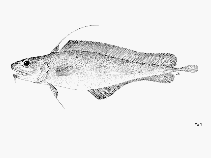
Environment: milieu / climate zone / Tiefenbereich / distribution range
Ökologie
seewasser bathypelagisch; tiefenbereich 127 - 2307 m (Ref. 104125), usually 500 - 900 m (Ref. 57668). Deep-water; 44°N - 38°N, 1°W - 17°E
Mediterranean Sea: northwestern region.
Length at first maturity / Size / Gewicht / Alter
Geschlechtsreife: Lm 29.5, range 20 - ? cm
Max length : 88.9 cm TL Männchen/unbestimmt; (Ref. 41039)
Rückenflossenstacheln (insgesamt) : 0; Afterflossenstacheln: 0. Posterior nostril immediately anterior to eye. Lateral line system on head with pit but no pores. Pyloric caeca 8 to 10.
Body shape (shape guide): fusiform / normal; Cross section: oval.
Most abundant in waters deeper than 750 m and feeds mainly on benthic organismsm crustaceans and also on polychaetes. Caught singly but also in aggregations of more than 100 individuals (Ref. 1371). Parasites of the species include trematodes, cestodes, nematodes, acanthocephalans and copepods; attached in the intestines, gills and fins (Ref. 5951). Minimum depth (Ref. 58426).
Life cycle and mating behavior
Geschlechtsreife | Fortpflanzung | Ablaichen | Eier | Fecundity | Larven
Barros-García, D., R. Bañón, J.-C. Arronte and A. de Carlos, 2016. New data reinforcing the taxonomic status of Lepidion eques as synonym of Lepidion lepidion (Teleostei, Gadiformes). Biochemical Systematics and Ecology 68(2016):6-10. (Ref. 109127)
IUCN Rote Liste Status (Ref. 130435: Version 2025-1)
Bedrohung für Menschen
Harmless
Nutzung durch Menschen
Fischereien: weniger kommerziell
Tools
Zusatzinformationen
Download XML
Internet Quellen
Estimates based on models
Preferred temperature (Ref.
123201): 13 - 13.7, mean 13.2 °C (based on 31 cells).
Phylogenetic diversity index (Ref.
82804): PD
50 = 0.5020 [Uniqueness, from 0.5 = low to 2.0 = high].
Bayesian length-weight: a=0.00288 (0.00180 - 0.00463), b=3.22 (3.08 - 3.36), in cm total length, based on LWR estimates for this species & (Sub)family-body (Ref.
93245).
Trophic level (Ref.
69278): 3.6 ±0.5 se; based on diet studies.
Widerstandsfähigkeit (Ref.
120179): niedrig, Verdopplung der Population dauert 4,5 - 14 Jahre. (Assuming tmax>10).
Fishing Vulnerability (Ref.
59153): High vulnerability (56 of 100).
🛈
Nutrients (Ref.
124155): Calcium = 28.6 [8.2, 76.2] mg/100g; Iron = 0.331 [0.144, 0.951] mg/100g; Protein = 18 [16, 20] %; Omega3 = 0.207 [0.075, 0.535] g/100g; Selenium = 17.1 [5.7, 44.6] μg/100g; VitaminA = 30 [4, 234] μg/100g; Zinc = 0.578 [0.318, 1.155] mg/100g (wet weight);