



Oreochromis rukwaensis (Hilgendorf & Pappenheim, 1903)
Lake Rukwa tilapia
Envoyez vos Photos et vidéos
Images | Images Google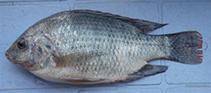 Oreochromis rukwaensis
Male Photo de Turner, G.F.
Images | Images Google
Male Photo de Turner, G.F.
Classification / Noms Noms communs | Synonymes | Catalog of Fishes(Genre, Espèce) | ITIS | CoL | WoRMS | Cloffa
> Cichliformes (Cichlids, convict blennies) > Cichlidae (Cichlids) > Pseudocrenilabrinae
Etymology: Oreochromis: Latin, aurum = gold + Greek, chromis = a fish, perhaps a perch (Ref. 45335).
More on authors: Hilgendorf & Pappenheim.
Etymology: Oreochromis: Latin, aurum = gold + Greek, chromis = a fish, perhaps a perch (Ref. 45335).
More on authors: Hilgendorf & Pappenheim.
Environnement : milieu / zone climatique / profondeur / gamme de distribution Écologie
; eau douce benthopélagique. Tropical; 7°S - 9°S
Distribution Territoires | Zones FAO | Écosystèmes | Occurrences | Carte par point | Introductions | Faunafri
Taille / Poids / Âge
Description synthétique Clés d'identification | Morphologie | Morphométrie
Épines dorsales (Total) : 15 - 17; Rayons mous dorsaux (Total) : 11 - 13; Épines anales: 3; Rayons mous anaux: 10 - 11; Vertèbres: 30. Diagnosis: Typical tilapiine cichlid, relatively deep bodied, with rather a small head (Ref. 118638). Other distinguishing characters are: caudal fin free of scales except basally; vertebrae 30; scales in lateral line series 30-32; dorsal spines XV-XVII; soft rays usually 11-13; outer teeth bicuspid, in mature fishes occasionally with a few tricuspids; lower gill-rakers 20-22; interorbital region in adults 34.5-40.0% length of head (Ref. 2). Ripe males have a dark body and fins, almost black, with bright red/orange margins on the dorsal and caudal fins; vertical barring can be noticeable in freshly caught specimens; head region in ripe males has a bluish sheen; ripe males have yellow-orange tassels; females and subadult males plain silver/grey with 6-7 post-opercular vertical stripes and bluish snout present in freshly caught specimens (Ref. 118638).
Body shape (shape guide): short and / or deep; Cross section: compressed.
Body shape (shape guide): short and / or deep; Cross section: compressed.
This species is found both in large lakes and small rivers (Ref. 4967, 118638). A maternal mouthbrooder (Ref. 118638). Males construct territories in shallow water; where there was ample space they were similar in structure and grouping to those of Oreochromis variabilis, each territory consisting of a central raised mating platform in the middle of a large circular depression (Ref. 2). It is a major component of the fisheries catch in Lake Rukwa and the Mtera Dam (Ref. 118638). Strong aquaculture potential given broad habitat requirements (Ref. 118638). IUCN conservation status is stated as vulnerable D2, declining population trend (Ref. 118638).
Cycle de vie et comportement reproducteur Maturité | Reproduction | Frai | Œufs | Fécondité | Larves
A maternal mouthbrooder (Ref. 118638). Males construct territories in shallow water; where there was ample space they were similar in structure and grouping to those of Oreochromis variabilis, each territory consisting of a central raised mating platform in the middle of a large circular depression; males occupy these territories at sunrise, when water temperature was 12°C and they left for deeper water in the late afternoon when the temperature rose to 25°C (Ref. 2). It exhibits pseudo-spawning and then true spawning follows (Ref. 2).
Référence principale
Téléchargez vos références | Références | Coordinateur : Kullander, Sven O. | Collaborateurs
Trewavas, E., 1983. Tilapiine fishes of the genera Sarotherodon, Oreochromis and Danakilia. British Mus. Nat. Hist., London, UK. 583 p. (Ref. 2)
Statut dans la liste rouge de l'IUCN (Ref. 130435: Version 2025-2 (Global))
Vulnérable (VU) (D2); Date assessed: 31 January 2006
CITES
Not Evaluated
Menace pour l'homme
Harmless
Utilisations par l'homme
Pêcheries: commercial
FAO - Publication: search | FishSource |
Plus d'informations
Écologie trophique
Aliments (proies)
Composition du régime alimentaire
Consommation alimentaire
Rations alimentaires
Prédateurs
Aliments (proies)
Composition du régime alimentaire
Consommation alimentaire
Rations alimentaires
Prédateurs
Dynamique des populations
Paramètres de croissance
Âges / tailles maximales
Longueur-poids rel.
Rel. longueur-longueur.
Fréquences de longueurs
Conversion de masse
Recrutement
Abondance
Paramètres de croissance
Âges / tailles maximales
Longueur-poids rel.
Rel. longueur-longueur.
Fréquences de longueurs
Conversion de masse
Recrutement
Abondance
Cycle de vie
Reproduction
Maturité
Maturité/épines rel.
Fécondité
Frai
Agrégats de frai
Œufs
Développement de l'œuf
Larves
Dynamique des populations larvaires
Reproduction
Maturité
Maturité/épines rel.
Fécondité
Frai
Agrégats de frai
Œufs
Développement de l'œuf
Larves
Dynamique des populations larvaires
Anatomie
Surface branchiale
Cerveau
Otolithe
Surface branchiale
Cerveau
Otolithe
Physiologie
Composition corporelle
Nutriments
Consommation d'oxygène
Type de natation
Vitesse de nage
Pigments visuels
Son de poisson
Maladies et parasites
Toxicité (CL50)
Composition corporelle
Nutriments
Consommation d'oxygène
Type de natation
Vitesse de nage
Pigments visuels
Son de poisson
Maladies et parasites
Toxicité (CL50)
Génétique
génôme
Génétique
Hétérozygotie
Héritabilité
Diversité génétique
génôme
Génétique
Hétérozygotie
Héritabilité
Diversité génétique
Liées à l'homme
Systèmes d'aquaculture
Profils d'aquaculture
Souches
Cas de ciguatera
Timbres, pièces de monnaie, divers
Systèmes d'aquaculture
Profils d'aquaculture
Souches
Cas de ciguatera
Timbres, pièces de monnaie, divers
Outils
E-book | Guide de terrain | Générateur de fréquences de longueur | Outil de dynamique de population | Carte par point |
Capture-MSY |
Articles particuliers
Télécharger en XML
Sources Internet
AFORO (otoliths) | Aquatic Commons | BHL | Cloffa | Websites from users | FishWatcher | CISTI | Catalog of Fishes: Genre, Espèce | DiscoverLife | ECOTOX | FAO - Publication: search | Faunafri | Fishipedia | Fishtrace | GloBI | Google Books | Google Scholar | Google | IGFA World Record | OneZoom | Open Tree of Life | Otolith Atlas of Taiwan Fishes | PubMed | Reef Life Survey | Socotra Atlas | TreeBase | Arbre de Vie | Wikipedia: aller à, chercher | World Records Freshwater Fishing | Zoological Record
Estimations basées sur des modèles
Indice de diversité phylogénétique (Réf. 82804): PD50 = 0.5000 [Uniqueness, from 0.5 = low to 2.0 = high].
Bayesian length-weight: a=0.01905 (0.00846 - 0.04293), b=3.01 (2.82 - 3.20), in cm total length, based on LWR estimates for this (Sub)family-body shape (Ref. 93245).
Résilience (Réf. 120179): Milieu, temps minimum de doublement de population : 1,4 à 4,4 années (Preliminary K or Fecundity.).