>
Cichliformes (Cichlids, convict blennies) >
Cichlidae (Cichlids) > Pseudocrenilabrinae
Etymology: Dimidiochromis: Greek, di = two + Latin, midio, dimidiatus = divided into halves, 1623 + Greek, chromis = afish, perhaps a perch (Ref. 45335).
More on author: Boulenger.
Environment: milieu / climate zone / profondeur / distribution range
Écologie
; eau douce benthopélagique; pH range: 8.0 - 8.0; dH range: 9 - 19. Tropical; 22°C - 28°C (Ref. 1672); 9°S - 17°S
Africa: widely distributed in Lake Malawi, upper Shire River and Lake Malombe.
Taille / Poids / Âge
Maturité: Lm ? range ? - ? cm
Max length : 23.0 cm TL mâle / non sexé; (Ref. 5627)
Description synthétique
Clés d'identification | Morphologie | Morphométrie
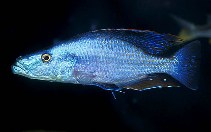
Diagnosis: easily recognised by its compressed head and body (Ref. 55954).
Body shape (shape guide): fusiform / normal.
Lives in vegetated areas in shallow water. Feeds on small fishes, mainly juvenile Utaka or other shoaling species (Ref. 5595).
Life cycle and mating behavior
Maturité | Reproduction | Frai | Œufs | Fécondité | Larves
Maréchal, C., 1991. Dimidiochromis. p. 76-78. In J. Daget, J.-P. Gosse, G.G. Teugels and D.F.E. Thys van den Audenaerde (eds.) Check-list of the freshwater fishes of Africa (CLOFFA). ISNB, Brussels; MRAC, Tervuren; and ORSTOM, Paris. Vol. 4. (Ref. 5627)
Statut dans la liste rouge de l'IUCN (Ref. 130435: Version 2025-1)
Menace pour l'homme
Harmless
Utilisations par l'homme
Pêcheries: commercial; Aquarium: Commercial
Outils
Articles particuliers
Télécharger en XML
Sources Internet
Estimates based on models
Phylogenetic diversity index (Réf.
82804): PD
50 = 0.5625 [Uniqueness, from 0.5 = low to 2.0 = high].
Bayesian length-weight: a=0.01445 (0.00674 - 0.03099), b=2.99 (2.82 - 3.16), in cm total length, based on LWR estimates for this (Sub)family-body shape (Ref.
93245).
Niveau trophique (Réf.
69278): 4.2 ±0.73 se; based on food items.
Résilience (Réf.
120179): Haut, temps minimum de doublement de population inférieur à 15 mois (Preliminary K or Fecundity.).
Fishing Vulnerability (Ref.
59153): Low vulnerability (13 of 100).
🛈