This website uses cookies to enhance your browsing experience and ensure the functionality of our site. For more detailed information about the types of cookies we use and how we protect your privacy, please visit our Privacy Information page.
×
Cookie Settings
This website uses different types of cookies to enhance your experience. Please select your preferences below:
> Cichliformes (Cichlids, convict blennies) > Cichlidae (Cichlids) > Pseudocrenilabrinae
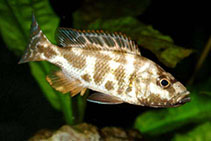
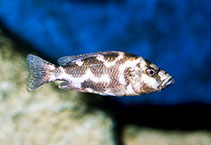
Etymology: Nimbochromis:Latin, nimbus = stormy, rainy + Greek, chromis, a fish, perhaps a perch; it has dark clouded melanic blotches on the body (Ref. 45335); livingstonii:Named after Dr. David Livingstone, famous explorer of the African continent. During one of his expeditions, the first fishes from Lake Malawi/Nyasa were collected for scientific studies (Ref. 55922). Eponymy: David Livingstone (1813–1873) was a Scottish doctor and missionary, and undoubtedly the most famous African explorer of all time. [...] (Ref. 128868), visit book page. More on author: Günther.
Umwelt: Milieu / Klimazone / Tiefenbereich / Verbreitungsgebiet Ökologie
Rückenflossenstacheln (insgesamt) : 15 - 16; Rückenflossenweichstrahlen (insgesamt) : 10 - 11; Afterflossenstacheln: 3; Afterflossenweichstrahlen: 9 - 10. Diagnosis: unique color pattern with 4 conspicuous dark bars radiating from the eye; body silvery, yellowish or blue with a highly contrasting black blotched pattern with anastomosing horizontal and vertical components; faint spots on the pectoral fins; no speckles on head and body; head length 34.0-37.0% of standard length; body depth 32.9-38.3% of standard length; dorsal fin base 49.6-53.7% of standard length; lower jaw 37.5-46.2% head length; head width 40.8-47.0% head length (Ref. 55922).
Occurs in all kinds of habitats but is more common in vegetated areas of sheltered bays (Ref. 5595). Prefers soft, muddy bottoms but is also seen in purely rocky environments (Ref. 5595, 55922). Feeds on fish (Ref. 5595). Has been observed to mimic as dead and then feed on small fish that get close (Ref. 3817, 13371, 55922). Is usually solitary and territorial (Ref. 3817).
Maréchal, C., 1991. Nimbochromis. p. 296-299. In J. Daget, J.-P. Gosse, G.G. Teugels and D.F.E. Thys van den Audenaerde (eds.) Check-list of the freshwater fishes of Africa (CLOFFA). ISNB, Brussels; MRAC, Tervuren; and ORSTOM, Paris. Vol. 4. (Ref. 4989)
IUCN Rote Liste Status (Ref. 130435: Version 2025-2 (Global))
Phylogenetischer Diversitätsindex (Ref. 82804): PD50 = 0.5312 [Uniqueness, from 0.5 = low to 2.0 = high].
Bayesian length-weight: a=0.01445 (0.00671 - 0.03113), b=2.99 (2.82 - 3.16), in cm total length, based on LWR estimates for this (Sub)family-body shape (Ref. 93245).
Trophische Ebene (Ref. 69278): 4.2 ±0.73 se; based on food items.
Widerstandsfähigkeit (Ref. 120179): mittel, Verdopplung der Population dauert 1,4 - 4,4 Jahre. (Fec<1000).
Anfälligkeit der Fischerei (Ref. 59153): Low vulnerability (15 of 100). 🛈