>
Syngnathiformes (Pipefishes and seahorses) >
Syngnathidae (Pipefishes and seahorses) > Nerophinae
Etymology: Doryrhamphus: Greek, dory = lance + Greek, rhamphos = bill, beak (Ref. 45335).
Environment: milieu / climate zone / Tiefenbereich / distribution range
Ökologie
seewasser riff-verbunden; tiefenbereich 1 - 30 m (Ref. 90102). Temperate
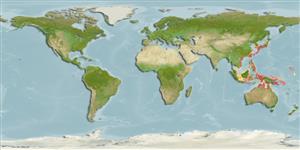
Western Pacific: Japan to Indonesia. Also from Korea Rep.
Size / Gewicht / Alter
Geschlechtsreife: Lm ? range ? - ? cm
Max length : 8.5 cm TL Männchen/unbestimmt; (Ref. 559)
Kurzbeschreibung
Bestimmungsschlüssel | Morphologie | Morphometrie
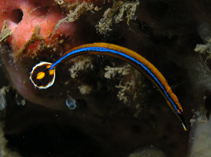
Rückenflossenweichstrahlen (insgesamt) : 21 - 23; Afterflossenweichstrahlen: 4. Body orange yellow when fresh. Trunk rings 20, tail rings 15. Lateral trunk ridge continuous with inferior tail ridge; superior trunk and tail ridges extending forward over 4 trunk rings. Three serrated ridges dorsally on snout, the median ridge heavily serrated. Body ridges illustrating single spine except anterior six of superior trunk ridge and 3 lateral trunk ridge which has double spines. No ventrolateral projection on the snout.
Body shape (shape guide): eel-like; Cross section: compressed.
Inhabits small caves in sublittoral rocky reefs. Reported from tide pools to depths of at least 25 m offshore, but mostly seen in shallow depths (Ref. 48635). An active cleaner that shares crevices with shrimps, large mud crabs and sometimes moray eels (Ref. 48635). Solitary or in pairs near sponges and Diadema sea urchins (Ref 90102). Ovoviviparous (Ref. 205). The male carries the eggs in a brood pouch which is found under the tail (Ref. 205). Spawns from the end of May to September.
Life cycle and mating behavior
Geschlechtsreife | Fortpflanzung | Ablaichen | Eier | Fecundity | Larven
Monogamous mating is observed as both obligate and genetic (Ref. 52884). Male carries the eggs in a brood pouch (Ref. 205).
Masuda, H., K. Amaoka, C. Araga, T. Uyeno and T. Yoshino, 1984. The fishes of the Japanese Archipelago. Vol. 1. Tokai University Press, Tokyo, Japan. 437 p. (text). (Ref. 559)
IUCN Rote Liste Status (Ref. 130435: Version 2025-1)
Bedrohung für Menschen
Harmless
Nutzung durch Menschen
Tools
Zusatzinformationen
Download XML
Internet Quellen
Estimates based on models
Preferred temperature (Ref.
123201): 20.7 - 29.3, mean 28.6 °C (based on 1159 cells).
Phylogenetic diversity index (Ref.
82804): PD
50 = 0.5010 [Uniqueness, from 0.5 = low to 2.0 = high].
Bayesian length-weight: a=0.00093 (0.00036 - 0.00242), b=3.05 (2.83 - 3.27), in cm total length, based on LWR estimates for this (Sub)family-body shape (Ref.
93245).
Trophic level (Ref.
69278): 3.7 ±0.50 se; based on food items.
Widerstandsfähigkeit (Ref.
120179): hoch, Verdopplung der Population dauert weniger als 15 Monate. (Preliminary K or Fecundity.).
Fishing Vulnerability (Ref.
59153): Low vulnerability (10 of 100).
🛈