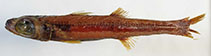
Epigonus atherinoides : fisheries

You can sponsor this page

Epigonus atherinoides (Gilbert, 1905)

Adicionar sua observação em Fish Watcher
Native range | All suitable habitat | Point map | Year 2050
This map was computer-generated and has not yet been reviewed.
Epigonus atherinoides   AquaMaps   Data sources: GBIF OBIS
Carregue seu(sua) Fotos e vídeos
Fotos | Imagem do Google
Image of Epigonus atherinoides
Epigonus atherinoides
Foto de Okamoto, M.

Classificação / Nomes Nomes comuns | Sinônimos | Catalog of Fishes(Gênero, Espécies) | ITIS | CoL | WoRMS | Cloffa

> Acropomatiformes (Oceanic basses) > Epigonidae (Deepwater cardinalfishes)
Etymology: Epigonus: Greek, epi = over, in front + Greek, gonio = angle (Ref. 45335).
More on author: Gilbert.

Environment: milieu / Zona climática / intervalo de profundidade / distribution range Ecologia

marinhas batidemersal; intervalo de profundidade 100 - 1200 m (Ref. 559). Deep-water

Distribuição Países | Áreas da FAO | Ecossistemas | Ocorrências | Mapa de pontos | Introduções | Faunafri

Pacific Ocean: Philippines and Kyushu-Palau Ridge, near the Hawaiian Islands and the Sala y Gomez Ridge.

Tamanho / Peso / Idade

Maturidade: Lm ?  range ? - ? cm
Max length : 15.0 cm SL macho/indeterminado; (Ref. 559)

Descrição suscinta Chaves de identificação | Morfologia | Morfometria

Espinhos dorsais (total) : 7; Raios dorsais (total) : 10. Well-developed opercular spines present. Distance between anal opening and the beginning of the anal fin is 27-41 percent of the distance between the base of pelvic fin and the anal opening (Ref. 31632).
Body shape (shape guide): fusiform / normal.

Biologia     Glossário (p.ex. epibenthic)

A mesobenthic-pelagic species living mainly above the bottom (Ref. 31632). Inhabits tops of seamounts (Ref. 559). Aggregations hovered over sand patches near steep, irregular cliffs (Ref. 7460).

Ciclo de vida ou comportamento de acasalamento Maturidade | Reprodução | Desova | Ovos | Fecundidade | Larvas

Referência principal Carregar suas referências | Referências | Coordenador | Colaboradores

Abramov, A.A., 1992. Species composition and distribution of Epigonus (Epigonidae) in the world ocean. J. Ichthyol. 32(5):94-108. (Ref. 31632)

Status na Lista Vermelha da UICN (Ref. 130435: Version 2025-1)


CITES

Not Evaluated

CMS (Ref. 116361)

Not Evaluated

Ameaça para os humanos

  Harmless


Uso pelos humanos

Pescarias: de interesse potencial
FAO - Publication: search | FishSource |

Mais informação

Ecologia Trófica
Food items (preys)
Composição da dieta
Consumo alimentar
Food rations
Predadores
Ecologia
Ecologia
Home ranges
Population dynamics
Parâmetros de crescimento
Max. ages / sizes
Length-weight rel.
Length-length rel.
Frequências de comprimento
Conversão de massa
Recrutamento
Abundância
Life cycle
Reprodução
Maturidade
Maturity/Gills rel.
Fecundidade
Desova
Spawning aggregations
Ovos
Desenvolvimento dos ovos
Larvas
Dinâmica larval
Distribuição
Países
Áreas da FAO
Ecossistemas
Ocorrências
Introduções
BRUVS - Videos
Anatomy
Área branquial
Brain
Otolith
Physiology
Body composition
Nutrients
Consumo de oxigênio
Tipo de natação
Velocidade de natação
Visual pigments
Fish sound
Diseases & Parasites
Toxicity (LC50s)
Genética
genoma
Genética
Heterozygosity
Hereditariedade
Human related
Aquaculture systems
Perfis para aquacultura
Estirpes
Ciguatera cases
Stamps, coins, misc.
Outreach
Colaboradores
Taxonomy
Nomes comuns
Sinônimos
Morfologia
Morfometria
Fotos
Referências
Referências

Ferramentas

Relatórios especiais

Baixar XML

Fontes da internet

AFORO (otoliths) | Aquatic Commons | BHL | Cloffa | Websites from users | Checar Observador de Peixes (FishWatcher) | CISTI | Catalog of Fishes: Gênero, Espécies | DiscoverLife | ECOTOX | FAO - Publication: search | Faunafri | Fishipedia | Fishtrace | GloBI | Google Books | Google Scholar | Google | IGFA World Record | OneZoom | Open Tree of Life | Otolith Atlas of Taiwan Fishes | PubMed | Reef Life Survey | Socotra Atlas | TreeBase | Árvore da vida | Wikipedia: Ir para, procura | Registro zoológico

Estimates based on models

Preferred temperature (Ref. 123201): 5.8 - 16.8, mean 10.1 °C (based on 252 cells).
Índice de diversidade filogenética (Ref. 82804):  PD50 = 0.5000   [Uniqueness, from 0.5 = low to 2.0 = high].
Bayesian length-weight: a=0.00646 (0.00275 - 0.01515), b=3.10 (2.89 - 3.31), in cm total length, based on LWR estimates for this (Sub)family-body shape (Ref. 93245).
Nível Trófico (Ref. 69278):  3.5   ±0.5 se; based on size and trophs of closest relatives
Resiliência (Ref. 120179):  médio(a), tempo mínimo de duplicação da população 1,4 - 4,4 anos (Assuming tm=2-4).
Fishing Vulnerability (Ref. 59153):  Low vulnerability (10 of 100). 🛈
Categoria de preço (Ref. 80766):   Low.