>
Blenniiformes (Blennies) >
Blenniidae (Combtooth blennies) > Salariinae
Etymology: Parablennius: Greek, para = the side of + Greek, blennios = mucus (Ref. 45335).
Eponymy: Ryōkichi Yatabe (1851–1899) was a Japanese botanist. He was also an ‘old friend’ of the authors, after becoming Cornell University’s first Japanese graduate. He drowned during a summer vacation. (Ref. 128868), visit book page.
More on authors: Jordan & Snyder.
Environment: milieu / climate zone / rango de profundidad / distribution range
Ecología
marino demersal; oceanodromo (Ref. 51243). Temperate
Northwest Pacific: southern Japan and Korea.
Tamaño / Peso / Age
Madurez: Lm ? range ? - ? cm
Max length : 9.0 cm TL macho / no sexado; (Ref. 56557)
Short description
Claves de identificación | Morfología | Morfometría
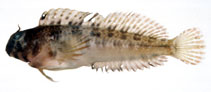
Espinas dorsales (total) : 12; Radios blandos dorsales (total) : 16 - 18; Espinas anales: 2; Radios blandos anales: 17 - 18. Gill opening wide, membranes broadly united and free from isthmus. Jaws with immovable teeth and a pair of canines posteriorly. Supraorbital cirrus present, longer in male. Body color extremely variable.
Body shape (shape guide): fusiform / normal; Cross section: circular.
Facultative air-breathing in the genus (Ref. 126274); Adults are common in rocky shore areas. They feed on algae and detritus (Ref. 9137). Attain less than 9 cm TL. Oviparous. Eggs are demersal and adhesive (Ref. 205), and are attached to the substrate via a filamentous, adhesive pad or pedestal (Ref. 94114). Larvae are planktonic, often found in shallow, coastal waters (Ref. 94114).
Life cycle and mating behavior
Madurez | Reproducción | Puesta | Huevos | Fecundidad | Larva
Oviparous, distinct pairing (Ref. 205).
Masuda, H., K. Amaoka, C. Araga, T. Uyeno and T. Yoshino, 1984. The fishes of the Japanese Archipelago. Vol. 1. Tokai University Press, Tokyo, Japan. 437 p. (text). (Ref. 559)
IUCN Red List Status (Ref. 130435: Version 2025-1)
Threat to humans
Harmless
Human uses
Herramientas
Special reports
Download XML
Fuentes de Internet
Estimates based on models
Preferred temperature (Referencia
123201): 17.4 - 27.4, mean 22.6 °C (based on 256 cells).
Phylogenetic diversity index (Referencia
82804): PD
50 = 0.5000 [Uniqueness, from 0.5 = low to 2.0 = high].
Bayesian length-weight: a=0.01096 (0.00465 - 0.02585), b=2.99 (2.81 - 3.17), in cm total length, based on LWR estimates for this Genus-body shape (Ref.
93245).
Nivel trófico (Referencia
69278): 2.0 ±0.00 se; based on food items.
Resiliencia (Referencia
120179): Alto, población duplicada en un tiempo mínimo inferior a 15 meses (Preliminary K or Fecundity.).
Fishing Vulnerability (Ref.
59153): Low vulnerability (10 of 100).
🛈