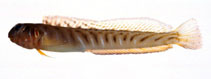
Environment: milieu / climate zone / Mức độ sâu / distribution range
Sinh thái học
Biển gần đáy. Subtropical
Northwest Pacific: southern Japan.
Bộ gần gũi / Khối lượng (Trọng lượng) / Age
Chín muồi sinh dục: Lm ? range ? - ? cm
Các tia vây lưng cứng (tổng cộng) : 12 - 14; Các vây lưng mềm (tổng cộng) : 19 - 22; Tia cứng vây hậu môn: 2; Tia mềm vây hậu môn: 21 - 25. Head without cirri and crest. Lower end of gill opening usually opposite 2nd or 3rd pectoral fin ray. Sensory pores in infraorbital and interorbital canals usually 8 and 3 respectively. Lateral line tubes 0 to 4.
Body shape (shape guide): fusiform / normal; Cross section: circular.
Adults are common in rocky shore areas. Attain less than 8 cm TL. Oviparous. Eggs are demersal and adhesive (Ref. 205), and are attached to the substrate via a filamentous, adhesive pad or pedestal (Ref. 94114). Larvae are planktonic, often found in shallow, coastal waters (Ref. 94114).
Life cycle and mating behavior
Chín muồi sinh dục | Sự tái sinh sản | Đẻ trứng | Các trứng | Sự sinh sản | Ấu trùng
Oviparous, distinct pairing (Ref. 205).
Masuda, H., K. Amaoka, C. Araga, T. Uyeno and T. Yoshino, 1984. The fishes of the Japanese Archipelago. Vol. 1. Tokai University Press, Tokyo, Japan. 437 p. (text). (Ref. 559)
IUCN Red List Status (Ref. 130435: Version 2025-1)
Threat to humans
Harmless
Human uses
Các công cụ
Special reports
Download XML
Các nguồn internet
Estimates based on models
Phylogenetic diversity index (Tài liệu tham khảo
82804): PD
50 = 0.5000 [Uniqueness, from 0.5 = low to 2.0 = high].
Bayesian length-weight: a=0.01047 (0.00434 - 0.02525), b=3.07 (2.86 - 3.28), in cm total length, based on LWR estimates for this (Sub)family-body shape (Ref.
93245).
Mức dinh dưỡng (Tài liệu tham khảo
69278): 2.7 ±0.2 se; based on size and trophs of closest relatives
Thích nghi nhanh (Tài liệu tham khảo
120179): Chiêù cao, thời gian nhân đôi của chủng quần tối thiểu là dưới 15 tháng (Preliminary K or Fecundity.).
Fishing Vulnerability (Ref.
59153): Low vulnerability (10 of 100).
🛈