



Polypterus retropinnis Vaillant, 1899
West African bichir
Hochladen Photos und videos
Bilder | Google Bild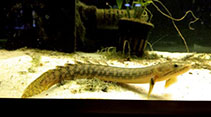 Polypterus retropinnis
Photo von Germeau, G.
Bilder | Google Bild
Photo von Germeau, G.
Klassifizierung / Names Namen | Synonyme | Catalog of Fishes(Gattung, Arten) | ITIS | CoL | WoRMS | Cloffa
> Polypteriformes (Bichirs) > Polypteridae (Bichirs)
Etymology: Polypterus: Greek, poly = a lot of + Greek, pteron = wing, fin (Ref. 45335).
More on author: Vaillant.
Etymology: Polypterus: Greek, poly = a lot of + Greek, pteron = wing, fin (Ref. 45335).
More on author: Vaillant.
Umwelt: Milieu / Klimazone / Tiefenbereich / Verbreitungsgebiet Ökologie
; süßwasser demersal. Tropical
Verbreitung Territorien | FAO Gebiete | Ökosysteme | Vorkommen | Punkt Karte | Einführungen | Faunafri
Africa: Ogowe and Congo River basins in Central Africa (Ref. 3188, 56367, 81628). Reports from West Africa (Ref. 4537) refer to Polypterus retropinnis lowei, which is now a synonym of Polypterus palmas (Ref. 122071).
Größe / Gewicht / Alter
Kurzbeschreibung Bestimmungsschlüssel | Morphologie | Morphometrie
Rückenflossenstacheln (insgesamt) : 7 - 9; Afterflossenstacheln: 12 - 15; Wirbelzahl: 55 - 58. Diagnosis: Polypterus retropinnis is distinguished from all other species of Polypterus except P. mokelembembe, P. ornatipinnis, P. teugelsi, P. polli and P. palmas in having a high predorsal-scale count: 26-34 vs. 11-25 (Ref. 56367). It differs from P. ornatipinnis, P. teugelsi and P. polli in having 56-59 lateral-line scales vs. 61-65 in P. ornatipinnis and P. teugelsi and 52-55 in P. polli; from P. palmas by having a single large black blotch on the pectoral-fin base vs. numerous small spots on posterior part of base; and from P. mokelembembe by having a narrower first dorsal-fin spine being 4,6-6,1% of head length vs. 6,4-8,1%, a greater internostril distance being 14,3-18,0% of head length vs. 11,6-13,7%, and more pectoral-fin rays, 30-34 vs. 23-29 (Ref. 56367). Jaws mostly about the same length, the upper jaw sometimes a little longer than lower jaw; pectoral fin not reaching dorsal-fin origin (Ref. 43035, 46852). In addition, living specimens of Polypterus retropinnis differ from all congeners in their iris coloration, which consists of creamy white areas and black dots alternating with each other around the iris; however, this character state is rarely visible in preserved specimens (Ref. 56367).
Body shape (shape guide): elongated; Cross section: circular.
Body shape (shape guide): elongated; Cross section: circular.
Facultative air-breathing (Ref. 126274); Mostly found in little rivers, swamps and flooded zones (Ref. 4910, 41580, 46852). Carnivorous (Ref. 41580).
Lebenszyklus und Paarungsverhalten Geschlechtsreife | Fortpflanzung | Ablaichen | Eier | Fruchtbarkeit | Larven
Hauptreferenz
Laden Sie Ihre Referenzen hoch | Referenzen | Koordinator | Partner
Britz, R., 2007. Polypteridae. p. 168-173. In M.L.J. Stiassny, G.G. Teugels and C.D. Hopkins (eds.) The fresh and brackish water fishes of Lower Guinea, West-Central Africa. Volume I. Collection Faune et Flore tropicales 42. Institut de Recherche pour le Développement, Paris, France, Muséum National d’Histoire Naturelle, Paris, France, and Musée Royal de l’Afrique Centrale, Tervuren, Belgium. 800 pp. (Ref. 81628)
IUCN Rote Liste Status (Ref. 130435: Version 2025-2 (Global))
nicht bedroht (LC) ; Date assessed: 07 June 2019
CITES
Not Evaluated
Bedrohung für Menschen
Harmless
Nutzung durch Menschen
Fischereien: nicht kommerziell
FAO - Publication: search | FishSource |
Mehr Information
Trophische Ökologie
Lebensmittel (Beutetiere)
Nahrungszusammensetzung
Nahrungsaufnahme
Lebensmittelrationen
Räuber
Lebensmittel (Beutetiere)
Nahrungszusammensetzung
Nahrungsaufnahme
Lebensmittelrationen
Räuber
Populationsdynamik
Wachstumsparameter
Max. Alter/Größen
Länge-Gewicht-Rel.
Länge-Länge-Verhältnis.
Längenhäufigkeiten
Massenkonvertierung
Rekrutierung
Dichte
Wachstumsparameter
Max. Alter/Größen
Länge-Gewicht-Rel.
Länge-Länge-Verhältnis.
Längenhäufigkeiten
Massenkonvertierung
Rekrutierung
Dichte
Lebenszyklus
Fortpflanzung
Geschlechtsreife
Reifung/Kiemen rel.
Fruchtbarkeit
Ablaichen
Laichaggregationen
Eier
Eientwicklung
Larven
Larven Pop.Dyn.
Fortpflanzung
Geschlechtsreife
Reifung/Kiemen rel.
Fruchtbarkeit
Ablaichen
Laichaggregationen
Eier
Eientwicklung
Larven
Larven Pop.Dyn.
Anatomie
Kiemenoberfläche
Gehirn
Otolith
Kiemenoberfläche
Gehirn
Otolith
Physiologie
Körperliche Zusammensetzung
Nährstoffe
Sauerstoffverbrauch
Schwimmart
Schwimmgeschwindigkeit
Visuelle Pigmente
Fischgeräusche
Krankheiten und Parasiten
Toxizität (LC50s)
Körperliche Zusammensetzung
Nährstoffe
Sauerstoffverbrauch
Schwimmart
Schwimmgeschwindigkeit
Visuelle Pigmente
Fischgeräusche
Krankheiten und Parasiten
Toxizität (LC50s)
Genetik
Genom
Genetik
Heterozygotie
Vererbbarkeit
Genetische Vielfalt
Genom
Genetik
Heterozygotie
Vererbbarkeit
Genetische Vielfalt
Menschenbezogen
Aquakultur-Systeme
Aquakultur Profile
Zuchtlinien
Ciguatera-Fälle
Briefmarken, Münzen, Verschiedenes.
Aquakultur-Systeme
Aquakultur Profile
Zuchtlinien
Ciguatera-Fälle
Briefmarken, Münzen, Verschiedenes.
Tools
E-Book | Feldführer | Bestimmungsschlüssel | Längenhäufigkeits Tool | Lebensdaten Tool | Punkt Karte |
Catch-MSY |
Zusatzinformationen
Download XML
Zusammenfassung | Punktdaten | Namen | Photos
Internet Quellen
AFORO (otoliths) | Aquatic Commons | BHL | Cloffa | Websites from users | FishWatcher Einträge suchen | CISTI | Catalog of Fishes: Gattung, Arten | DiscoverLife | ECOTOX | FAO - Publication: search | Faunafri | Fishipedia | Fishtrace | GloBI | Google Books | Google Scholar | Google | IGFA World Record | OneZoom | Open Tree of Life | Otolith Atlas of Taiwan Fishes | Öffentliche Aquarien | PubMed | Reef Life Survey | Socotra Atlas | TreeBase | Tree of Life | Wikipedia: Gehe zu, Suchen | World Records Freshwater Fishing | Zoobank | Zoologischer Rekord
Schätzungen auf der Grundlage von Modellen
Phylogenetischer Diversitätsindex (Ref. 82804): PD50 = 0.5003 [Uniqueness, from 0.5 = low to 2.0 = high].
Bayesian length-weight: a=0.00457 (0.00194 - 0.01077), b=3.05 (2.85 - 3.25), in cm total length, based on LWR estimates for this (Sub)family-body shape (Ref. 93245).
Trophische Ebene (Ref. 69278): 2.6 ±0.26 se; based on food items.
Widerstandsfähigkeit (Ref. 120179): hoch, Verdopplung der Population dauert weniger als 15 Monate. (Preliminary K or Fecundity.).