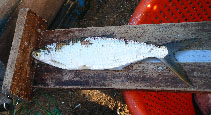
Issue
Three subspecies were described on the basis of different morphological characters: tchadense Blache, 1964, soudanensis and eburneensis Paugy, 1986. However they should rather be considered as populations having equivalent ecological characteristics (D. Paugy, pers,comm 21 Mar. 2013).
Environment: milieu / Zona climática / intervalo de profundidade / distribution range
Ecologia
; Água doce bentopelágico; pH range: 6.5 - 7.8; dH range: ? - 30; potamódromo (Ref. 51243). Tropical; 15°C - 35°C
Africa: Senegal, Gambia, the coastal basins of the Côte d'Ivoire (Comoé, Bandama and Sassandra), Volta, Niger/Benué and Chad basin (Ref. 2880, 81279). Also present in Nile, Omo, Lake Albert and Lake Turkana (Ref. 2880, 28714). Three populations - previously as subspecies - may be distinguished by slight morphological differences but they have the same ecological charasterics: in Nile River, Lake Albert, Omo River and Lake Turkana ('baremoze'); in Senegal River, Gambia River, Tominé River, Volta basin, Niger basin and Chad basin ('soudaniensis'); in coastal basins of Côte d'Ivoire, namely Sassandra River, Bandama River and Comoé River ('eburneensis') (Ref. 42019).
Comprimento de primeira maturação / Tamanho / Peso / Idade
Maturidade: Lm 20.9, range 25 - ? cm
Max length : 43.0 cm TL macho/indeterminado; (Ref. 2703); 40.0 cm TL (female); peso máx. publicado: 500.00 g (Ref. 3023); idade máx. registrada: 6 anos (Ref. 2758)
Espinhos dorsais (total) : 0; Raios dorsais (total) : 10; Espinhos anais: 0; Raios anais : 22 - 31; Vértebras: 41 - 49. Diagnosis: at least 30 gill rakers on lower limb of first gill arch (30-41); 38-51 lateral line scales, with 7.5-9.5 above and 3.5 below; anal fin with three simple rays and 19-28 branched rays; dorsal-fin origin distinctly behind level of pelvic-fin insertions (Ref. 2759, 81279).
Body shape (shape guide): fusiform / normal; Cross section: oval.
Mainly diurnal. There is considerable flexibility in its diet, A. baremoze shifts from zooplankton to zoobenthos, detritus and macrophytes as plankton densities decline (Ref. 28714). Occurs at a temperature range of 14.6-35.0°C. In the Malamfatori area (Tchad), seine-net fishery on the River Yobe depends on seasonal upstream (from Lake Chad) and downstream migration during the flood (August-December) and dry (January-March) seasons, respectively. Also, there is an intensive gillnet fishery from July-October at the river mouth. A. baremoze moves offshore (in Lake Chad) beginning March.
Spawning cycle from Tables XVI-XVIII of Ref. 2759 for maturity stages 3-4 GSI 1.5-16% from deltaic zone, upstream (Logone-Chari River), downstream (N'Djamena) and in the southeastern archipelago of Lake Chad. Spawning takes place from 16:30-20:00 h. Eggs spawned in one batch representing 15% of weight of female. Mature females dispersed, not forming groups.
Teugels, G.G., C. Lévêque, D. Paugy and K. Traoré, 1988. État des connaissances sur la faune ichtyologique des bassins côtiers de Côte d'Ivoire et de l'ouest du Ghana. Rev. Hydrobiol. Trop. 21(3):221-237. (Ref. 272)
Status na Lista Vermelha da UICN (Ref. 130435: Version 2025-1)
Ameaça para os humanos
Harmless
Uso pelos humanos
Pescarias: altamente comercial
Ferramentas
Relatórios especiais
Baixar XML
Fontes da internet
Estimates based on models
Índice de diversidade filogenética (Ref.
82804): PD
50 = 0.5078 [Uniqueness, from 0.5 = low to 2.0 = high].
Bayesian length-weight: a=0.01047 (0.00833 - 0.01316), b=3.02 (2.96 - 3.08), in cm total length, based on LWR estimates for this species (Ref.
93245).
Nível Trófico (Ref.
69278): 3.1 ±0.35 se; based on food items.
Generation time: 1.6 (1.3 - 2.6) years. Estimated as median ln(3)/K based on 10
growth studies.
Resiliência (Ref.
120179): médio(a), tempo mínimo de duplicação da população 1,4 - 4,4 anos (K=0.42; tm=2-3; tmax=6).
Fishing Vulnerability (Ref.
59153): Low vulnerability (22 of 100).
🛈
Nutrients (Ref.
124155): Calcium = 104 [37, 225] mg/100g; Iron = 1.52 [0.79, 3.43] mg/100g; Protein = 18.4 [16.4, 20.5] %; Omega3 = 0.458 [0.176, 1.204] g/100g; Selenium = 85.2 [36.2, 188.1] μg/100g; VitaminA = 29.9 [11.8, 71.1] μg/100g; Zinc = 1.79 [1.29, 2.49] mg/100g (wet weight);