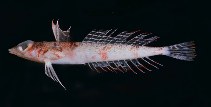
Draconetta xenica, Highfin slope dragonet

You can sponsor this page

Draconetta xenica Jordan & Fowler, 1903

Highfin slope dragonet
Beobachtung melden im Fish Watcher
Native range | All suitable habitat | Point map | Year 2050
This map was computer-generated and has not yet been reviewed.
Draconetta xenica   AquaMaps   Data sources: GBIF OBIS
Hochladen Photos und videos
Bilder | Google Bild
Image of Draconetta xenica (Highfin slope dragonet)
Draconetta xenica
Photo von Randall, J.E.

Klassifizierung / Names Namen | Synonyme | Catalog of Fishes(Gattung, Arten) | ITIS | CoL | WoRMS | Cloffa

> Callionymiformes (Dragonets) > Draconettidae (Slope dragonets)
Etymology: Draconetta: Greek, drako = dragon (Ref. 45335).
More on authors: Jordan & Fowler.

Environment: milieu / climate zone / Tiefenbereich / distribution range Ökologie

seewasser demersal; tiefenbereich 128 - 367 m (Ref. 58302). Deep-water

Verbreitung Länder | FAO Gebiete | Ecosystems | Vorkommen | Punkt Karte | Einführungen | Faunafri

Indo-Pacific: East Africa to Hawaiian Islands.

Size / Gewicht / Alter

Geschlechtsreife: Lm ?  range ? - ? cm
Max length : 9.0 cm SL Männchen/unbestimmt; (Ref. 559)

Kurzbeschreibung Bestimmungsschlüssel | Morphologie | Morphometrie

Rückenflossenstacheln (insgesamt) : 3; Rückenflossenweichstrahlen (insgesamt) : 12; Afterflossenweichstrahlen: 12. Spines of first dorsal fin flexible, long and slender. Second dorsal fin with soft 12 rays (Ref 42912).
Body shape (shape guide): elongated.

Biologie     Fachlexikon (Englisch) (z.B. epibenthic)

Inhabits continental edges (Ref. 13707); benthic on sand (Ref. 58302).

Life cycle and mating behavior Geschlechtsreife | Fortpflanzung | Ablaichen | Eier | Fecundity | Larven

Hauptreferenz Upload your references | Referenzen | Koordinator : Fricke, Ronald | Partner

Fricke, R., 1992. Revision of the family Draconettidae (Teleostei), with descriptions of two new species and a new subspecies. J. Nat. Hist. 26(1):165-195. (Ref. 13707)

IUCN Rote Liste Status (Ref. 130435: Version 2025-1)


CITES

Not Evaluated

CMS (Ref. 116361)

Not Evaluated

Bedrohung für Menschen

  Harmless


Nutzung durch Menschen

FAO - Publication: search | FishSource |

Mehr Information

Trophic ecology
Food items (preys)
Nahrungszusammensetzung
Nahrungsaufnahme
Food rations
Räuber
Ökologie
Ökologie
Home ranges
Population dynamics
Growth parameters
Max. ages / sizes
Length-weight rel.
Length-length rel.
Längenhäufigkeiten
Mass conversion
Rekrutierung
Dichte
Life cycle
Fortpflanzung
Geschlechtsreife
Maturity/Gills rel.
Fecundity
Ablaichen
Spawning aggregations
Eier
Eientwicklung
Larven
Larven Pop.Dyn.
Verbreitung
Länder
FAO Gebiete
Ecosystems
Vorkommen
Einführungen
BRUVS - Videos
Anatomy
Kiemenoberfläche
Brain
Otolith
Physiology
Body composition
Nutrients
Oxygen consumption
Swimming type
Swimming speed
Visual pigments
Fish sound
Diseases & Parasites
Toxicity (LC50s)
Genetik
Genom
Genetik
Heterozygosity
Vererbbarkeit
Human related
Aquaculture systems
Aquakultur Profile
Zuchtlinien
Ciguatera cases
Stamps, coins, misc.
Outreach
Partner
Referenzen
Referenzen

Tools

Zusatzinformationen

Download XML

Internet Quellen

AFORO (otoliths) | Aquatic Commons | BHL | Cloffa | Websites from users | FishWatcher Einträge suchen | CISTI | Catalog of Fishes: Gattung, Arten | DiscoverLife | ECOTOX | FAO - Publication: search | Faunafri | Fishipedia | Fishtrace | GloBI | Google Books | Google Scholar | Google | IGFA World Record | Nationale Datenbanken | OneZoom | Open Tree of Life | Otolith Atlas of Taiwan Fishes | PubMed | Reef Life Survey | Socotra Atlas | TreeBase | Tree of Life | Wikipedia: Gehe zu, Suchen | Zoobank | Zoological Record

Estimates based on models

Preferred temperature (Ref. 123201): 12.2 - 20.7, mean 15.7 °C (based on 209 cells).
Phylogenetic diversity index (Ref. 82804):  PD50 = 1.0000   [Uniqueness, from 0.5 = low to 2.0 = high].
Bayesian length-weight: a=0.00389 (0.00180 - 0.00842), b=3.12 (2.94 - 3.30), in cm total length, based on all LWR estimates for this body shape (Ref. 93245).
Trophic level (Ref. 69278):  3.3   ±0.5 se; based on size and trophs of closest relatives
Fishing Vulnerability (Ref. 59153):  Low vulnerability (10 of 100). 🛈