



アップロード 写真 そして ビデオ
画像 | グーグルの画像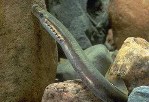 Lampetra aepyptera
画像によって The Native Fish Conservancy
画像 | グーグルの画像
画像によって The Native Fish Conservancy
分類 / 名前 共通名の | 類義語 | Catalog of Fishes(部類, 種) | ITIS | CoL | WoRMS | Cloffa
> Petromyzontiformes (Lampreys) > Petromyzontidae (Northern lampreys) > Lampetrinae
Etymology: Lampetra: lambo (L.), to lick; petra (Gr.), rock or stone, referring to their suctorial behavior (adults attach to rocks during nest building and mating) (See ETYFish); aepyptera: aepy-, from aipys (Gr.), high; ptera (Gr.), fin, referring to enlarged dorsal fins of nuptial males (See ETYFish).
Etymology: Lampetra: lambo (L.), to lick; petra (Gr.), rock or stone, referring to their suctorial behavior (adults attach to rocks during nest building and mating) (See ETYFish); aepyptera: aepy-, from aipys (Gr.), high; ptera (Gr.), fin, referring to enlarged dorsal fins of nuptial males (See ETYFish).
Taxonomic Remarks
The taxonomic position of this species is uncertain. It is provisionally placed in the genus Lampetra but further study may show that it should more appropriately be placed in the genus Okkelbergia Creaser and Hubbs 1922. It is the only species in the genus that possesses both exolateral and posterial teeth.
環境:環境 / 気候帯 / 深さの範囲 / 分布範囲 生態学
; 新鮮な水 底生の; pH range: 6.0 - 7.3. Temperate; 4°C - 19°C (Ref. 89241); 42°N - 31°N
分布 領土 | 国連食糧農業機関の区域 | エコシステム | 事件 | 目的のマップ | 導入 | Faunafri
North America: Atlantic Slope from Susquehanna River drainage in southeastern Pennsylvania to Neuse River drainage in North Carolina, USA; Mississippi River basin from Pennsylvania to Missouri and Arkansas south to Alabama, USA; Mobile Bay and Pascagoula River drainages in Georgia, Alabama and Mississippi, USA.
サイズ / 重さ / 年齢
成熟: Lm ? range ? - ? cm
Max length : 18.0 cm TL オス/雌雄の選別がない; (Ref. 5723); common length : 12.1 cm TL オス/雌雄の選別がない; (Ref. 12193); 最大記録サイズ: 8 年 (Ref. 12193)
Max length : 18.0 cm TL オス/雌雄の選別がない; (Ref. 5723); common length : 12.1 cm TL オス/雌雄の選別がない; (Ref. 12193); 最大記録サイズ: 8 年 (Ref. 12193)
簡単な記述 検索表 | 形態学 | 形態計測学
Characterized by having oral disc narrower than head; teeth extremely degenerated; usually 52-59 trunk myomeres; coloration consisting of light tan to silver gray above, yellow or white below; and yellow or gray fins (Ref. 86798). Other adult diagnostic features: 7.5-17.8 cm TL and wet weight 0.9-3.0 g for individuals 8.2-12.0 cm TL. Body proportions, as percentage of TL (based on 166 specimens measuring 7.5-16.5 cm TL): prebranchial length, 6.9-13.0; branchial length, 8.4-12.8; trunk length, 42.8-57.3; tail length, 23.4-35.0; eye length, 0.9-2.1; disc length, 2.8-6.7. Urogenital papilla length, as a percentage of branchial length, in 71 spawning males measuring 10.2-14.6 cm TL, 23.1-60.0. Trunk myomeres, 53-62. Dentition: marginals, 63-67; supraoral lamina, 2 unicuspid teeth; infraoral lamina, 5-13 unicuspid teeth; 3-4 endolaterals on each side; endolateral formula, 2-1-2 with variations, including 1-1-1, 2-3-2 and 2-3-3; 2 rows of anterials; first row of anterials, 4-5 unicuspid teeth (some teeth may even be found on the anterior field between the supraoral lamina and the first row of anterials); 1-2 rows of exolaterals on each side; 0-1 row of posterials; first row of posterials, when present, may be complete (13% of individuals) or incomplete (87%) with 1-22 unicuspid teeth; transverse lingual lamina, undetermined number of unicuspid teeth, the median one of undetermined size; longitudinal lingual laminae each with an undetermined number of unicuspid teeth. Velar tentacles, 3-5, with tubercles. Body coloration (live) of spawning individuals, dorsal aspect mottled gray-brown and ventral aspect light silvery-yellow. Lateral line neuromast pigmentation unrecorded. Caudal fin pigmentation, darkly pigmented, but the extent of coverage has not been reported. Caudal fin shape, spade-like. Oral fimbriae number unrecorded. Oral papillae, 12-20 (Ref. 89241).
Body shape (shape guide): eel-like.
Body shape (shape guide): eel-like.
Freshwater, in streams and lakes (Ref. 89241). Inhabit clean, clear gravel riffles and runs of creeks and small rivers (Ref. 3814). In Delaware, occurs in small streams with relatively slow current, usually 0.03 m/s or less, with water temperatures throughout the year 4.0-19.0 °C, dissolved oxygen 5.6-14.0 ppm, and pH 6.0-7.3. In Kentucky, occurs in small to medium size, clear creeks with sand-gravel substrate, either among debris (adults) or in mud banks with silt deposits (ammocoetes) (Ref. 89241). Ammocoete larvae occur in spring-fed wetlands and quiet pools and backwaters of small, sandy or muddy bottom streams (Ref. 3814). Larval period varies from 2.5 to at least 5.4 yrs. Metamorphosis in early September and maybe even mid- to late August. In Maryland, metamorphosis has been reported as late as February (Ref. 89241). Adults enter riffle areas to spawn at 10-16°C water temperature (Ref. 10294). Non-parasitic (Ref. 3814). Fecundity, 572-3,816 eggs/female and relative fecundity, 373-687 eggs/g body weight. Egg diameter, 0.66-1.36 mm. In Delaware, spawning occurs at the end of March at a water temperature of 13.8 °C, dissolved oxygen 11.6 ppm, and pH 6.6. In Maryland, spawning occurs from 10 April to 10 May when the water reaches 16 °C. Both sexes participate in nest building. Stones up to 2.5 cm in diameter are moved using their oral disc. Nests are circular or oval, 15-2 cm in diameter and about 7 cm deep. They are built in streams 4.5-.3 m wide and 15-1 cm deep with a substrate of sand and fine gravel. From 2-5 lampreys share a nest. Up to two males will spawn with one female. Average size at hatching, 3.4 mm TL. Modal length at age 1 is 27-8 mm TL and at age 2 is 50 mm TL. Most growth occurs during the spring season, intermediate growth in summer and fall and very little during winter. In Kentucky, mean length at age 1 is 39 mm TL, at age 2 is 65 mm TL, and at age 3 is 89 mm TL (Ref. 89241).
ライフサイクルと交尾行動 成熟 | 繁殖 | 放精 | 卵 | 生産力 | 幼生
The female attaches with her oral disc to a rock at the upstream end of the nest. The male attaches to the back of her head using his oral disc and wraps his tail around her trunk region in such a way as to have each others urogenital papilla in close proximity and through muscular contraction of his body assists in the extrusion of the eggs. They vibrate
vigorously for a few seconds. This results in the release of their gametes and disturbance of the substrate, which partially buries the fertilized eggs (Ref. 89241). One female pairs up with up to two males (Ref. 89241).
主な参考文献
参考文献のアップロード | 参考文献 | コーディネーター | 協力者
Robins, C.R., R.M. Bailey, C.E. Bond, J.R. Brooker, E.A. Lachner, R.N. Lea and W.B. Scott, 1991. Common and scientific names of fishes from the United States and Canada. Am. Fish. Soc. Spec. Publ. (20):183 p. (Ref. 3814)
CITES
Not Evaluated
人間に対する脅威
Harmless
人間の用途
FAO - Publication: search | FishSource |
より多くの情報
解剖学
カマ
脳
オトリス
カマ
脳
オトリス
生理学
体組成
栄養素
酸素消費
水泳タイプ
泳ぐ速さ
視覚色素
フィッシュ・サウンド
病気と寄生虫
毒性(LC50)
体組成
栄養素
酸素消費
水泳タイプ
泳ぐ速さ
視覚色素
フィッシュ・サウンド
病気と寄生虫
毒性(LC50)
用具
特記事項
XMLをダウンロードして下さい
インターネットの情報源
AFORO (otoliths) | Aquatic Commons | BHL | Cloffa | Websites from users | Check FishWatcher | CISTI | Catalog of Fishes: 部類, 種 | DiscoverLife | ECOTOX | FAO - Publication: search | Faunafri | Fishipedia | Fishtrace | GloBI | Google Books | Google Scholar | Google | IGFA World Record | OneZoom | Open Tree of Life | Otolith Atlas of Taiwan Fishes | PubMed | Reef Life Survey | Socotra Atlas | TreeBase | 生命の木 | Wikipedia: 行く, 検索する | World Records Freshwater Fishing | 動物に関する記録
モデルに基づく推定値
系統多様性指数 (参照 82804): PD50 = 0.5010 [Uniqueness, from 0.5 = low to 2.0 = high].
Bayesian length-weight: a=0.00170 (0.00095 - 0.00304), b=2.96 (2.80 - 3.12), in cm total length, based on LWR estimates for this species & (Sub)family-body (Ref. 93245).
栄養段階 (参照 69278): 3.4 ±0.4 se; based on size and trophs of closest relatives
回復力 (参照 120179): 低い, 4.5年~14年の倍増期間の最小個体群 (Semelparous species, assuming tm (= tmax) > 4).