



Alopias vulpinus (Bonnaterre, 1788)
Thresher
個人による観察記録の追加 Fish Watcher
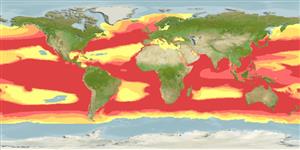
| Native range | All suitable habitat | Point map | Year 2050 |
|
| This map was computer-generated and has not yet been reviewed. |
| Alopias vulpinus AquaMaps Data sources: GBIF OBIS |
分類 / 名前 共通名の | 類義語 | Catalog of Fishes(部類, 種) | ITIS | CoL | WoRMS | Cloffa
板鰓亜鋼(サメとエイ類) (sharks and rays) > Lamniformes (Mackerel sharks) > Alopiidae (Thresher sharks)
Etymology: Alopias: From alopex, Greek for fox, referring to the ancient vernacular “fox shark,” from its supposed cunning (ancients believed that when it took a bait, it swallowed the hook until it got to the cord, which it bit off and so escaped) (See ETYFish); vulpinus: Latin for fox-like (as for genus) (See ETYFish).
More on author: Bonnaterre.
Etymology: Alopias: From alopex, Greek for fox, referring to the ancient vernacular “fox shark,” from its supposed cunning (ancients believed that when it took a bait, it swallowed the hook until it got to the cord, which it bit off and so escaped) (See ETYFish); vulpinus: Latin for fox-like (as for genus) (See ETYFish).
More on author: Bonnaterre.
環境:環境 / 気候帯 / 深さの範囲 / 分布範囲 生態学
海 pelagic-oceanic; 海洋回遊性 (Ref. 87829); 深さの範囲 0 - 650 m (Ref. 106604), usually 0 - 200 m (Ref. 55168). Subtropical; 74°N - 58°S, 180°W - 180°E (Ref. 54279)
分布 領土 | 国連食糧農業機関の区域 | エコシステム | 事件 | 目的のマップ | 導入 | Faunafri
Cosmopolitan in temperate and tropical seas (Ref. 6871, 58085). Population considered reduced (R) in the US Atlantic waters; lower risk/conservation dependent (LR/CD) in US Pacific waters; data deficient (DD) in the rest of Atlantic and rest of Pacific (Ref. 12451). Highly migratory species.
初回成熟時の長さ / サイズ / 重さ / 年齢
成熟: Lm 351.0, range 226 - 400 cm
Max length : 573 cm TL オス/雌雄の選別がない; (Ref. 106604); 549.0 cm TL (female); common length : 450 cm TL オス/雌雄の選別がない; (Ref. 5217); 最大公表体重: 348.0 kg (Ref. 40637); 最大記録サイズ: 25 年 (Ref. 81241)
Max length : 573 cm TL オス/雌雄の選別がない; (Ref. 106604); 549.0 cm TL (female); common length : 450 cm TL オス/雌雄の選別がない; (Ref. 5217); 最大公表体重: 348.0 kg (Ref. 40637); 最大記録サイズ: 25 年 (Ref. 81241)
簡単な記述 検索表 | 形態学 | 形態計測学
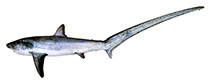
背面の脊椎 (合計) : 0; 肛門の骨: 0. A large thresher with relatively small eyes, curved, narrow-tipped pectoral fins, a narrow-tipped caudal fin, and a conspicuous white patch over the pectoral fin bases (Ref. 5578). Second dorsal origin well behind the rear tip of the pelvic fin (Ref. 559). Upper lobe of caudal fin very long and strap-like, about as long as or longer than length of rest of shark; lower lobe short but well developed (Ref. 13570). Brown, grey, blue-grey, or blackish on back and underside of snout, lighter on sides and abruptly white below; a white area extends from the abdomen over the pectoral-fin bases; pectoral-, pelvic-, and dorsal fins blackish, white dots sometimes present on pectoral-, pelvic-, and caudal- fin tips (Ref. 13570).
Body shape (shape guide): fusiform / normal; Cross section: circular.
Body shape (shape guide): fusiform / normal; Cross section: circular.
Coastal over continental and insular shelves and epipelagic far from land (Ref. 30573, 43278, 58302). Oceanic although most abundant near land, pelagic at 1-366 m (Ref. 58302). Young often close inshore and in shallow bays (Ref. 5578). Feeds on schooling fishes (including mackerels, bluefishes, clupeids, needlefishes, lancetfishes and lanternfishes), squid, octopi, pelagic crustaceans, and rarely seabirds (Ref. 247). Ovoviviparous, embryos feeding on yolk sac and other ova produced by the mother (Ref. 43278, 50449). Uses its long caudal fin to bunch up and stun prey (Ref. 2850). Spatial and depth segregation by sex in northwestern Indian Ocean populations (Ref. 247). A few attacks on boats are doubtfully attributed to this species, but it is otherwise apparently harmless to humans, though the size of adults of this species command respect (Ref. 247). May cause damage to fishing gear (Ref. 6885). Valued for its meat, liver, hide, and fins; utilized fresh, dried-salted, smoked, and frozen (Ref. 9987).
ライフサイクルと交尾行動 成熟 | 繁殖 | 放精 | 卵 | 生産力 | 幼生
Ovoviviparous, embryos feed solely on the ova produced by the mother after the yolk sac is absorbed (oophagy) (Ref. 50449), 2 to 4 young in a litter (usually 2) (Ref. 247). Size at birth 114-150 cm (Ref. 247). Distinct pairing with embrace (Ref. 205).
主な参考文献
参考文献のアップロード | 参考文献 | コーディネーター : Compagno, Leonard J.V. | 協力者
Compagno, L.J.V., 1984. FAO Species Catalogue. Vol. 4. Sharks of the world. An annotated and illustrated catalogue of shark species known to date. Part 1 - Hexanchiformes to Lamniformes. FAO Fish. Synop. 125(4/1):1-249. Rome, FAO. (Ref. 247)
IUCNのレッドリストの状況は (Ref. 130435: Version 2025-2 (Global))
脆弱 (VU) (A2bd); Date assessed: 06 November 2018
人間に対する脅威
Harmless (Ref. 247)
人間の用途
水産業: 商業; ゲームフィッシュ: はい
FAO - 水産業: 着陸, 種の外形; Publication: search | FishSource | 私達の周りの海
より多くの情報
用具
特記事項
XMLをダウンロードして下さい
インターネットの情報源
AFORO (otoliths) | Aquatic Commons | BHL | Cloffa | Websites from users | Check FishWatcher | CISTI | Catalog of Fishes: 部類, 種 | DiscoverLife | DORIS | ECOTOX | FAO - 水産業: 着陸, 種の外形; Publication: search | Faunafri | Fishipedia | Fishtrace | GloBI | GoMexSI (interaction data) | Google Books | Google Scholar | Google | IGFA World Record | 国のデーターベース | OneZoom | Open Tree of Life | Otolith Atlas of Taiwan Fishes | PubMed | Reef Life Survey | RFE Identification | Socotra Atlas | TreeBase | 生命の木 | Wikipedia: 行く, 検索する | World Records Freshwater Fishing | 動物に関する記録
モデルに基づく推定値
好ましい温度 (参照 123201): 11.6 - 28.2, mean 23.3 °C (based on 8352 cells).
系統多様性指数 (参照 82804): PD50 = 0.7500 [Uniqueness, from 0.5 = low to 2.0 = high].
Bayesian length-weight: a=0.00851 (0.00364 - 0.01988), b=2.86 (2.66 - 3.06), in cm total length, based on LWR estimates for this species & (Sub)family-body (Ref. 93245).
栄養段階 (参照 69278): 4.5 ±0.0 se; based on diet studies.
Generation time: 11.0 ( na - na) years. Estimated as median ln(3)/K based on 2 growth studies.
回復力 (参照 120179): 低い, 4.5年~14年の倍増期間の最小個体群 (K=0.1; tm=5-7; tmax=19; Fec=2-4).
Prior r = 0.05, 95% CL = 0.03 - 0.07, Based on 1 full stock assessment.
栄養素 (Ref. 124155): Calcium = 6.93 [1.98, 35.15] mg/100g; Iron = 0.726 [0.178, 2.143] mg/100g; Protein = 20.7 [18.3, 23.1] %; Omega3 = 0.379 [0.152, 0.923] g/100g; Selenium = 37.8 [10.7, 110.5] μg/100g; VitaminA = 4.78 [1.56, 14.81] μg/100g; Zinc = 0.28 [0.14, 0.52] mg/100g (wet weight);