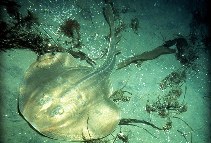
Platyrhinoidis triseriata, Thornback guitarfish

You can sponsor this page

Platyrhinoidis triseriata (Jordan & Gilbert, 1880)

Thornback guitarfish
Add your observation in Fish Watcher
Native range | All suitable habitat | Point map | Year 2050
This map was computer-generated and has not yet been reviewed.
Platyrhinoidis triseriata   AquaMaps   Data sources: GBIF OBIS
Upload your photos and videos
Các tranh (Ảnh) | Google image
Image of Platyrhinoidis triseriata (Thornback guitarfish)
Platyrhinoidis triseriata
Picture by Gotshall, D.W.

Classification / Names Tên thường gặp | Các synonym ( Các tên trùng) | Catalog of Fishes(Giống, Các loài) | ITIS | CoL | WoRMS | Cloffa

Lớp phụ Cá sụn (cá mập và cá đuối) (sharks and rays) > Torpediniformes (Electric rays) > Platyrhinidae (Fanrays)
Etymology: Platyrhinoidis: Greek, platys = flat + Greek, rhinos = nose + Greek, oides = similar to (Ref. 45335).
More on authors: Jordan & Gilbert.

Environment: milieu / climate zone / Mức độ sâu / distribution range Sinh thái học

Biển gần đáy; Mức độ sâu 0 - 137 m (Ref. 96339). Subtropical; 38°N - 23°N, 124°W - 108°W (Ref. 114953)

Sự phân bố Các nước | Các khu vực của FAO | Các hệ sinh thái | Những lần xuất hiện | Bản đồ điểm | Những chỉ dẫn | Faunafri

Eastern Pacific: San Francisco, USA to Baja California, Mexico.

Length at first maturity / Bộ gần gũi / Khối lượng (Trọng lượng) / Age

Chín muồi sinh dục: Lm ?, range 48 - ? cm
Max length : 91.0 cm TL con đực/không giới tính; (Ref. 2850)

Sinh học     Tự điển (thí dụ epibenthic)

Inhabits fine sand to mud bottom, often near kelp beds and sometimes abundant on mud flats of coastal bays. Often buries itself in bottom sediments. Ranges from the intertidal zone to 50 m depth (Ref. 12951). Solitary or in small groups, gathers in shallow bays, lagoons, and off beaches (Ref. 12951, Ref. 114953). Feeds on small sand-dwelling crustaceans, worms and mollusks. Ovoviviparous (Ref. 50449), with 1 to 15 pups in a litter (Ref. 48844), mainly in August (Ref. 114953). Possesses ampullary electroreceptors with a region of maximum sensitivity of 5-15 Hz (Ref. 10011).

Life cycle and mating behavior Chín muồi sinh dục | Sự tái sinh sản | Đẻ trứng | Các trứng | Sự sinh sản | Ấu trùng

Exhibit ovoviparity (aplacental viviparity), with embryos feeding initially on yolk, then receiving additional nourishment from the mother by indirect absorption of uterine fluid enriched with mucus, fat or protein through specialised structures (Ref. 50449).

Main reference Upload your references | Các tài liệu tham khảo | Người điều phối | Người cộng tác

Eschmeyer, W.N., E.S. Herald and H. Hammann, 1983. A field guide to Pacific coast fishes of North America. Boston (MA, USA): Houghton Mifflin Company. xii+336 p. (Ref. 2850)

IUCN Red List Status (Ref. 130435: Version 2025-1)

  Least Concern (LC) ; Date assessed: 07 October 2015

CITES

Not Evaluated

CMS (Ref. 116361)

Not Evaluated

Threat to humans

  Harmless (Ref. 12951)


Human uses

FAO - Publication: search | FishSource |

Thêm thông tin

Sinh thái dinh dưỡng
Food items (preys)
Thành phần thức ăn
Thành phần thức ăn
Food rations
Các động vật ăn mồi
Sinh thái học
Sinh thái học
Home ranges
Population dynamics
Growth parameters
Max. ages / sizes
Length-weight rel.
Length-length rel.
Length-frequencies
Mass conversion
Bổ xung
Sự phong phú
Life cycle
Sự tái sinh sản
Chín muồi sinh dục
Maturity/Gills rel.
Sự sinh sản
Đẻ trứng
Spawning aggregations
Các trứng
Egg development
Ấu trùng
Sự biến động ấu trùng
Sự phân bố
Các nước
Các khu vực của FAO
Các hệ sinh thái
Những lần xuất hiện
Những chỉ dẫn
BRUVS - Videos
Anatomy
Vùng mang
Brain
Otolith
Physiology
Body composition
Nutrients
Thành phần ô-xy
Dạng bơi
Tốc độ bơi
Visual pigments
Fish sound
Diseases & Parasites
Toxicity (LC50s)
Di truyền
Genome
Di truyền
Heterozygosity
Di sản
Human related
Aquaculture systems
Các tổng quan nuôi trồng thủy sản
Các giống
Ciguatera cases
Stamps, coins, misc.
Taxonomy
Tên thường gặp
Các synonym ( Các tên trùng)
Hình thái học
Sinh trắc học
Các tranh (Ảnh)
Các tài liệu tham khảo

Các công cụ

Special reports

Download XML

Các nguồn internet

AFORO (otoliths) | Aquatic Commons | BHL | Cloffa | Websites from users | Check FishWatcher | CISTI | Catalog of Fishes: Giống, Các loài | DiscoverLife | ECOTOX | FAO - Publication: search | Faunafri | Fishipedia | Fishtrace | GloBI | Google Books | Google Scholar | Google | IGFA World Record | OneZoom | Open Tree of Life | Otolith Atlas of Taiwan Fishes | PubMed | Reef Life Survey | Socotra Atlas | TreeBase | Cây Đời sống | Wikipedia: Go, tìm | Tạp chí Zoological Record

Estimates based on models

Preferred temperature (Tài liệu tham khảo 123201): 15.3 - 23.1, mean 20.6 °C (based on 38 cells).
Phylogenetic diversity index (Tài liệu tham khảo 82804):  PD50 = 1.0312   [Uniqueness, from 0.5 = low to 2.0 = high].
Bayesian length-weight: a=0.01000 (0.00244 - 0.04107), b=3.04 (2.81 - 3.27), in cm total length, based on all LWR estimates for this body shape (Ref. 93245).
Mức dinh dưỡng (Tài liệu tham khảo 69278):  3.4   ±0.42 se; based on food items.
Thích nghi nhanh (Tài liệu tham khảo 120179):  Rất thấp, thời gian nhân đôi của chủng quần tối thiểu là hơn 14 năm (Fec = 1).
Fishing Vulnerability (Ref. 59153):  High vulnerability (56 of 100). 🛈