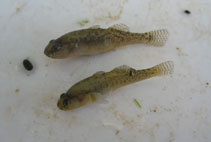
>
Gobiiformes (Gobies) >
Gobiidae (Gobies) > Gobionellinae
Etymology: Economidichthys: Greek, oikonomos = manager of a household, steward (Ref. 45335).
Eponymy: Professor Dr Panos Stavros Economidis was formerly Director of the Ichthyology and Zoology Laboratories in the School of Biology, Aristotle University of Thessaloniki and was the main contributor to its fish collection. [...] (Ref. 128868), visit book page.
Environment: milieu / climate zone / intervalo de profundidade / distribution range
Ecologia
; Água doce demersal. Temperate; 40°N - 38°N
Europe: in rivers and streams of western Greece, north of the Patraikos Gulf, including Lefkas Island; its likely occurrence to the north in Albania remains to be established.
Tamanho / Peso / Idade
Maturidade: Lm ? range ? - ? cm
Max length : 5.1 cm TL macho/indeterminado; (Ref. 12215); 5.4 cm TL (female)
Descrição breve
Chaves de identificação | Morfologia | Morfometria
Espinhos anais: 1; Raios anais moles: 7 - 10; Vértebras: 28 - 31. Body dark or with short transverse lateral blotches or bars, never more than half body depth; perianal organ present, at least half length of pelvic disc; pelvic anterior membrane deeply emarginate or absent in ventral midline; body contiguously scaled from axil to caudal fin base and abdomen naked.
Body shape (shape guide): elongated.
A short-lived species which inhabits both flowing and stagnant shallows with abundant vegetation and detrital substrate. Spawns in March and April (Ref. 26100). Feeds on invertebrates, mainly on amphipods and copepods. Females may spawn more than once during a season. Up to 600 eggs are spawns by several females in a single nest. Eggs (2.4 x 0.9 mm) are spawned in a cavity (often inside standing, broken reeds); these are cleaned and guarded by the males. The eggs hatch probably in one day, larvae living on the bottom; both male and female dying shortly after spawning (Ref.59043).
Life cycle and mating behavior
Maturidade | Reprodução | Desova | Ovos | Fecundidade | Larvas
Miller, P.J., 1990. The endurance of endemism: the Mediterranean freshwater gobies and their prospects for survival. J. Fish Biol. 37(Suppl.A):145-156. (Ref. 12215)
Categoria na Lista Vermelha da IUCN (Ref. 130435: Version 2025-1)
Ameaça para o homem
Harmless
Utilização humana
Pescarias: sem interesse
Ferramentas
Relatórios especiais
Descarregue XML
Fontes da internet
Estimates based on models
Phylogenetic diversity index (Ref.
82804): PD
50 = 0.7500 [Uniqueness, from 0.5 = low to 2.0 = high].
Bayesian length-weight: a=0.00832 (0.00444 - 0.01558), b=3.06 (2.90 - 3.22), in cm total length, based on LWR estimates for this species & (Sub)family-body (Ref.
93245).
Nível Trófico (Ref.
69278): 3.5 ±0.37 se; based on food items.
Resiliência (Ref.
120179): Elevada, tempo mínimo de duplicação da população menor que 15 meses (Preliminary K or Fecundity.).
Fishing Vulnerability (Ref.
59153): Low vulnerability (10 of 100).
🛈