



Entosphenus folletti Vladykov & Kott, 1976
Northern California brook lamprey
Hochladen Photos und videos
Bilder | Google Bild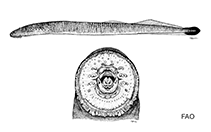 Entosphenus folletti
Male Photo von FAO
Bilder | Google Bild
Male Photo von FAO
Klassifizierung / Names Namen | Synonyme | Catalog of Fishes(Gattung, Arten) | ITIS | CoL | WoRMS | Cloffa
> Petromyzontiformes (Lampreys) > Petromyzontidae (Northern lampreys) > Lampetrinae
Etymology: Entosphenus: entos (Gr.), within; sphenos (Gr.), wedge, referring to wedge-shaped tooth within mouth on tongue of E. tridentatus (See ETYFish); folletti: In honor of Wilbur (“Bill”) I. Follett (1901-1992), Curator of Fishes, California Academy of Sciences, “friend, a collaborator in the studies of holarctic lampreys, and a distinguished scholar of the fishes of California” [authors incorrectly gave Follett’s name as “William”] (See ETYFish).
Eponymy: Wilbur Irving ‘Bill’ Follett (1901–1992) was a lawyer by profession but an ichthyologist by choice. He was Curator, Department of Ichthyology, California Academy of Sciences (1947–1969). (Ref. 128868), visit book page.
Etymology: Entosphenus: entos (Gr.), within; sphenos (Gr.), wedge, referring to wedge-shaped tooth within mouth on tongue of E. tridentatus (See ETYFish); folletti: In honor of Wilbur (“Bill”) I. Follett (1901-1992), Curator of Fishes, California Academy of Sciences, “friend, a collaborator in the studies of holarctic lampreys, and a distinguished scholar of the fishes of California” [authors incorrectly gave Follett’s name as “William”] (See ETYFish).
Eponymy: Wilbur Irving ‘Bill’ Follett (1901–1992) was a lawyer by profession but an ichthyologist by choice. He was Curator, Department of Ichthyology, California Academy of Sciences (1947–1969). (Ref. 128868), visit book page.
Umwelt: Milieu / Klimazone / Tiefenbereich / Verbreitungsgebiet Ökologie
; süßwasser demersal; standorttreu. Subtropical
Verbreitung Territorien | FAO Gebiete | Ökosysteme | Vorkommen | Punkt Karte | Einführungen | Faunafri
North America: known only from the types collected from Willow Creek, upper Klamath river system, California.
Größe / Gewicht / Alter
Kurzbeschreibung Bestimmungsschlüssel | Morphologie | Morphometrie
Rückenflossenstacheln (insgesamt) : 0; Afterflossenstacheln: 0. Adults: 17.6-22.8 cm TL; body proportions, as percentage of TL (based on 6 specimens measuring 18.6-22.8 cm TL): 12.3-14.5 prebranchial length, 9.2-10.6 branchial length, 42.7-48.6 trunk length, 28.4-32.7 tail length, 1.7-2.3 eye length and 6.6-7.8 disc length; 5.7 urogenital papilla length (percentage of branchial length in one spawning male measuring 21 cm TL); trunk myomeres, 61-65. Adult dentition: supraoral lamina, 3 unicuspid teeth, the median one smaller than the lateral ones; infraoral lamina, 5 unicuspid teeth; 4 endolaterals on each side; endolateral formula, typically 2-3-3-2, the fourth endolateral can also be unicuspid; 1-2 rows of anterials; first row of anterials, 2 unicuspid teeth; exolaterals absent; 1 row of posterials with 13-18 teeth, of which 0-4 are bicuspid and the rest unicuspid (some of these teeth may be embedded in the oral mucosa); transverse lingual lamina, 14-20 unicuspid teeth, the median one slightly enlarged; longitudinal lingual laminae teeth are too poorly developed to be counted. Velar tentacles in adults, 8-9, with tubercles; median tentacle is about the same size as the lateral ones immediately next to it; body coloration (preserved), dark brown on dorsal, lateral, and ventral aspects; lateral line neuromasts darkly pigmented; second dorsal fin pigmentation, +++; caudal fin pigmentation, +++; caudal fin shape, spade-like; oral papillae, 13.
Body shape (shape guide): eel-like.
Body shape (shape guide): eel-like.
Freshwater; in creeks and rivers (Ref. 89241). Non-parasitic lamprey; adults do not feed but remain in the streams where they soon spawn and die. Ammocoetes larvae live as filter feeders in the bottom mud for at least 4 years before metamorphosis.
Lebenszyklus und Paarungsverhalten Geschlechtsreife | Fortpflanzung | Ablaichen | Eier | Fruchtbarkeit | Larven
Hauptreferenz
Laden Sie Ihre Referenzen hoch | Referenzen | Koordinator | Partner
McGinnis, S.M., 1984. Freshwater fishes of California. University of California Press, Berkeley. 316 p. (Ref. 12280)
CITES
Not Evaluated
Bedrohung für Menschen
Harmless
Nutzung durch Menschen
Fischereien: nicht kommerziell
FAO - Publication: search | FishSource |
Mehr Information
Trophische Ökologie
Lebensmittel (Beutetiere)
Nahrungszusammensetzung
Nahrungsaufnahme
Lebensmittelrationen
Räuber
Lebensmittel (Beutetiere)
Nahrungszusammensetzung
Nahrungsaufnahme
Lebensmittelrationen
Räuber
Ökologie
Ökologie
Ökologie
Populationsdynamik
Wachstumsparameter
Max. Alter/Größen
Länge-Gewicht-Rel.
Länge-Länge-Verhältnis.
Längenhäufigkeiten
Massenkonvertierung
Rekrutierung
Dichte
Wachstumsparameter
Max. Alter/Größen
Länge-Gewicht-Rel.
Länge-Länge-Verhältnis.
Längenhäufigkeiten
Massenkonvertierung
Rekrutierung
Dichte
Lebenszyklus
Fortpflanzung
Geschlechtsreife
Reifung/Kiemen rel.
Fruchtbarkeit
Ablaichen
Laichaggregationen
Eier
Eientwicklung
Larven
Larven Pop.Dyn.
Fortpflanzung
Geschlechtsreife
Reifung/Kiemen rel.
Fruchtbarkeit
Ablaichen
Laichaggregationen
Eier
Eientwicklung
Larven
Larven Pop.Dyn.
Anatomie
Kiemenoberfläche
Gehirn
Otolith
Kiemenoberfläche
Gehirn
Otolith
Physiologie
Körperliche Zusammensetzung
Nährstoffe
Sauerstoffverbrauch
Schwimmart
Schwimmgeschwindigkeit
Visuelle Pigmente
Fischgeräusche
Krankheiten und Parasiten
Toxizität (LC50s)
Körperliche Zusammensetzung
Nährstoffe
Sauerstoffverbrauch
Schwimmart
Schwimmgeschwindigkeit
Visuelle Pigmente
Fischgeräusche
Krankheiten und Parasiten
Toxizität (LC50s)
Genetik
Genom
Genetik
Heterozygotie
Vererbbarkeit
Genetische Vielfalt
Genom
Genetik
Heterozygotie
Vererbbarkeit
Genetische Vielfalt
Menschenbezogen
Aquakultur-Systeme
Aquakultur Profile
Zuchtlinien
Ciguatera-Fälle
Briefmarken, Münzen, Verschiedenes.
Aquakultur-Systeme
Aquakultur Profile
Zuchtlinien
Ciguatera-Fälle
Briefmarken, Münzen, Verschiedenes.
Tools
E-Book | Feldführer | Bestimmungsschlüssel | Längenhäufigkeits Tool | Lebensdaten Tool | Punkt Karte |
Catch-MSY |
Zusatzinformationen
Download XML
Zusammenfassung | Punktdaten | Namen | Photos
Internet Quellen
AFORO (otoliths) | Aquatic Commons | BHL | Cloffa | Websites from users | FishWatcher Einträge suchen | CISTI | Catalog of Fishes: Gattung, Arten | DiscoverLife | ECOTOX | FAO - Publication: search | Faunafri | Fishipedia | Fishtrace | GloBI | Google Books | Google Scholar | Google | IGFA World Record | OneZoom | Open Tree of Life | Otolith Atlas of Taiwan Fishes | PubMed | Reef Life Survey | Socotra Atlas | TreeBase | Tree of Life | Wikipedia: Gehe zu, Suchen | World Records Freshwater Fishing | Zoobank | Zoologischer Rekord
Schätzungen auf der Grundlage von Modellen
Phylogenetischer Diversitätsindex (Ref. 82804): PD50 = 0.5156 [Uniqueness, from 0.5 = low to 2.0 = high].
Bayesian length-weight: a=0.00132 (0.00060 - 0.00290), b=2.99 (2.80 - 3.18), in cm total length, based on LWR estimates for this (Sub)family-body shape (Ref. 93245).
Trophische Ebene (Ref. 69278): 4.2 ±0.7 se; based on size and trophs of closest relatives
Widerstandsfähigkeit (Ref. 120179): niedrig, Verdopplung der Population dauert 4,5 - 14 Jahre. (assuming tm=5).