>
Anabantiformes (Gouramies, snakeheads) >
Osphronemidae (Gouramies) > Macropodusinae
Etymology: Betta: Malay/Javanese origin. Bleeker (1850, 1858) indicates Ikan Wadder Bettah as the local name of Betta trifasciata Bleeker, 1849 (now Betta picta, Valenciennes, 1846) in the Ambarawa Javanese dialect. Ikan Wader is a common Javanese name for smaller freshwater fishes, especially cyprinids (already used in Old Javanese). See Blust, R. & Trussel, S. Austronesian Comparative Dictionary. Web Edition (https://www.trussel2.com/acd/).
Eponymy: Dietrich Schaller is a German aquarist and importer of tropical fish. [...] (Ref. 128868), visit book page.
More on authors: Kottelat & Ng.
Environment: milieu / climate zone / distribuzione batimetrica / distribution range
Ecologia
; acqua dolce benthopelagico. Tropical
Asia: presently known only from Banka, Indonesia.
Size / Peso / Age
Maturità: Lm ? range ? - ? cm
Max length : 4.5 cm SL maschio/sesso non determinato; (Ref. 12803)
Short description
Chiavi di identificazione | Morfologia | Morfometria
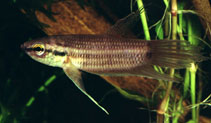
Spine dorsali (totale) : 2; Raggi dorsali molli (totale) : 8 - 9; Spine anali: 2 - 4; Raggi anali molli: 23 - 25. Distinguished from other members from Sumatra, Indonesia in the following characters: more anal fin rays (27 vs. 23-25); more dorsal fin rays than Betta cracens and Betta fusca (10-11 vs. 8-9); more subdorsal scales than Betta cracens and B. fusca (6 1/2-7 vs. 5 1/2-6); more lateral scales than B. fusca (31 vs. 29); fewer lateral scales than Betta cracens (31 vs. 32-33); fewer predorsal scales than Betta cracens, Betta fusca and Betta raja (17-19 vs. 20-24); greater head length than Betta pugnax, Betta cracens and Betta fusca (35-.5-36.5% SL vs. 27.5-35.2); smaller predorsal length than Betta fusca (62.7-66.3% SL vs. 68.5-70.2); greater preanal length than Betta cracens (47.8-50.9% SL vs. 42.0-46.1); greater body depth than Betta cracens (26.7-27.6% SL vs. 21.2-24.2); greater dorsal fin base length than Betta cracens (12.4-13.9% SL vs. 10.5-11.6); smaller anal fin base length than Betta cracens (50.4-52.0% SL vs. 53.4-55.7); greater orbital diameter than Betta cracens and Betta fusca (61-76% postorbital length vs. 47-58) (Ref. 56386).
Body shape (shape guide): fusiform / normal.
Facultative air-breathing (Ref. 126274); Found in forest swamp, peat swamp and hill stream.
Life cycle and mating behavior
Maturità | Riproduzione | Deposizione | Uova | Fecundity | Larve
Kottelat, M. and P.K.L. Ng, 1994. Diagnoses of five new species of fighting fishes from Banka and Borneo (Teleostei: Belontiidae). Ichthyol. Explor. Freshwat. 5(1):65-78. (Ref. 12803)
IUCN Red List Status (Ref. 130435: Version 2025-1)
Threat to humans
Harmless
Human uses
Strumenti
Special reports
Download XML
Fonti Internet
Estimates based on models
Phylogenetic diversity index (Fonte Biblio.
82804): PD
50 = 0.5000 [Uniqueness, from 0.5 = low to 2.0 = high].
Bayesian length-weight: a=0.01000 (0.00377 - 0.02651), b=2.97 (2.74 - 3.20), in cm total length, based on LWR estimates for this (Sub)family-body shape (Ref.
93245).
Trophic level (Fonte Biblio.
69278): 3.2 ±0.4 se; based on size and trophs of closest relatives
Resilienza (Fonte Biblio.
120179): Alto, tempo minimo di raddoppiamento della popolazione meno di 15 mesi (Preliminary K or Fecundity.).
Fishing Vulnerability (Ref.
59153): Low vulnerability (10 of 100).
🛈