>
Gobiiformes (Gobies) >
Gobiidae (Gobies) > Gobionellinae
Etymology: Schismatogobius: Greek, schisma, -atos = crack, fissure + latin, gobius = gudgeon (Ref. 45335).
Environment: milieu / climate zone / rango de profundidad / distribution range
Ecología
; agua dulce demersal. Temperate
Asia: Japan, Taiwan and Philippines.
Tamaño / Peso / Age
Madurez: Lm ? range ? - ? cm
Max length : 2.7 cm SL macho / no sexado; (Ref. 12955); 2.4 cm SL (female)
Short description
Claves de identificación | Morfología | Morfometría
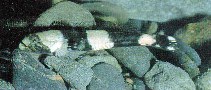
Espinas dorsales (total) : 7; Radios blandos dorsales (total) : 9; Espinas anales: 1; Radios blandos anales: 9. This species is distinguished by the following characters: pectoral-fin rays 15-16; body is relatively slender (depth at pelvic-fin origin 16.6-19.0% of SL); trunk is relatively longer (pre-dorsal length 37.7-40.1% of SL; preanal length 56.1-59.5% of SL; pre-anal-fin length 60.3-64.5% of SL; length of second dorsal-fin base 24.8-28.3% of SL; length of anal-fin base 20.0-23.1% of SL). Colouration: one dark brown, broad transverse band on posterior half of the body; pectoral fin with a large, obvious black patch on the upper part extending nearly to the distal tip of fin; larger males with isthmus and gular region dark brown, but usually cream or white in females and smaller males; pelvic fin with many melanophores in larger males, but with few or no melanophores in females and smaller males (Ref. 125666).
Body shape (shape guide): elongated; Cross section: oval.
Found in the lower freshwater reaches of streams, 50 to 800 m from the upper limit of tidal fluctuations. The habitat is almost the same as that of S. ninja and they were often observed syntopically, and sometimes with Schismatogobius marmoratus. Major syntopic fishes were also the same as those with S. ninja. This species also has camouflage coloration. This species often spreads its pectoral fins and flutters them and although the proximal part of the large black patch on the pectoral fin is covered by white pigmentation on the anterior side, it lacks white pigmentation on the posterior side. Thus, the black patch on the posterior side is conspicuous during the fluttering behavior. They communicate with other individuals by this behavior, but the meaning is unknown (Ref. 125666).
Life cycle and mating behavior
Madurez | Reproducción | Puesta | Huevos | Fecundidad | Larva
Chen, I.-S., K.-T. Shao and L.-S. Fang, 1995. A new species of freshwater goby Schismatogobius ampluvinculus (Pisces: Gobiidae) from southeastern Taiwan. Zoological Studies 34(3):202-205. (Ref. 12955)
IUCN Red List Status (Ref. 130435: Version 2025-1)
Threat to humans
Harmless
Human uses
Herramientas
Special reports
Download XML
Fuentes de Internet
Estimates based on models
Phylogenetic diversity index (Referencia
82804): PD
50 = 0.5000 [Uniqueness, from 0.5 = low to 2.0 = high].
Bayesian length-weight: a=0.00724 (0.00338 - 0.01553), b=3.05 (2.87 - 3.23), in cm total length, based on LWR estimates for this (Sub)family-body shape (Ref.
93245).
Nivel trófico (Referencia
69278): 3.1 ±0.5 se; based on size and trophs of closest relatives
Resiliencia (Referencia
120179): Alto, población duplicada en un tiempo mínimo inferior a 15 meses (Preliminary K or Fecundity.).
Fishing Vulnerability (Ref.
59153): Low vulnerability (10 of 100).
🛈