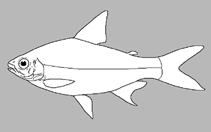
>
Characiformes (Characins) >
Curimatidae (Toothless characins)
Etymology: Pseudocurimata: Greek, pseudes = false + see under Curimata.
Eponymy: James Erwin Böhlke (1930–1982) and his wife Eugenia Louisa Böhlke née Brandt (1929–2001) were both ichthyologists who worked at the Academy of Natural Sciences of Philadelphia, where he was Curator of Ichthyology (1954–1982). [...] (Ref. 128868), visit book page.
More on author: Vari.
Issue
See Vari (1989:21) for detailed description.
Environment: milieu / climate zone / profondeur / distribution range
Écologie
; eau douce démersal. Tropical
South America: Esmeraldas and Santiago River basins in Ecuador.
Taille / Poids / Âge
Maturité: Lm ? range ? - ? cm
Max length : 10.9 cm SL mâle / non sexé; (Ref. 13243)
Description synthétique
Clés d'identification | Morphologie | Morphométrie
Rayons mous dorsaux (Total) : 11 - 12; Rayons mous anaux: 9 - 10.
Life cycle and mating behavior
Maturité | Reproduction | Frai | Œufs | Fécondité | Larves
Vari, R.P., 1989. Systematics of the neotropical characiform genus Psuedocurimata Fernández-Yépez (Pisces: Ostariophysi). Smithson. Contri. Zool. No. 490, 28 p. (Ref. 13243)
Statut dans la liste rouge de l'IUCN (Ref. 130435: Version 2025-1)
Menace pour l'homme
Harmless
Utilisations par l'homme
Outils
Articles particuliers
Télécharger en XML
Sources Internet
Estimates based on models
Phylogenetic diversity index (Réf.
82804): PD
50 = 0.5156 [Uniqueness, from 0.5 = low to 2.0 = high].
Bayesian length-weight: a=0.01175 (0.00453 - 0.03045), b=3.08 (2.85 - 3.31), in cm total length, based on LWR estimates for this (Sub)family-body shape (Ref.
93245).
Résilience (Réf.
120179): Haut, temps minimum de doublement de population inférieur à 15 mois (Preliminary K or Fecundity.).
Fishing Vulnerability (Ref.
59153): Low vulnerability (10 of 100).
🛈