Environment: milieu / climate zone / rango de profundidad / distribution range
Ecología
marino batipelágico; rango de profundidad 300 - 2626 m (Ref. 44036). Deep-water
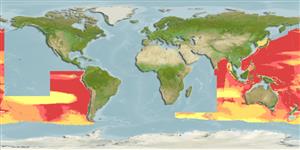
Indo-West Pacific: Bay of Bengal (Ref. 26282), Solomon Sea (Ref. 6993), New Zealand (Ref. 5755), and Japan (Ref. 35851). Southeast Pacific: Chile (Ref. 9068). South China Sea (Ref.74511)
Tamaño / Peso / Age
Madurez: Lm ? range ? - ? cm
Max length : 4.2 cm SL macho / no sexado; (Ref. 44036)
Short description
Claves de identificación | Morfología | Morfometría
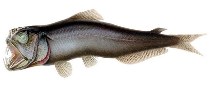
Radios blandos dorsales (total) : 12; Radios blandos anales: 27; Vértebra: 46. Body moderately elongate, deep strongly compressed. Body and head naked. Skin smooth, delicate and easily torn. Head and body dark brown with brassy green iridescence in alcohol (Ref. 35851).
Body shape (shape guide): elongated.
Life cycle and mating behavior
Madurez | Reproducción | Puesta | Huevos | Fecundidad | Larva
Kailola, P.J., 1987. The fishes of Papua New Guinea. A revised and annotated checklist. Vol. 1. Myxinidae to Synbranchidae. Research Bulletin No. 41. Department of Fisheries and Marine Resources, Port Moresby, Papua New Guinea. 194 p. (Ref. 6993)
IUCN Red List Status (Ref. 130435: Version 2025-1)
Threat to humans
Harmless
Human uses
Herramientas
Special reports
Download XML
Fuentes de Internet
Estimates based on models
Preferred temperature (Referencia
123201): 2.8 - 7.7, mean 4.7 °C (based on 1184 cells).
Phylogenetic diversity index (Referencia
82804): PD
50 = 0.7539 [Uniqueness, from 0.5 = low to 2.0 = high].
Bayesian length-weight: a=0.00427 (0.00160 - 0.01136), b=3.12 (2.89 - 3.35), in cm total length, based on LWR estimates for this (Sub)family-body shape (Ref.
93245).
Nivel trófico (Referencia
69278): 4.2 ±0.73 se; based on food items.
Fishing Vulnerability (Ref.
59153): Low vulnerability (10 of 100).
🛈