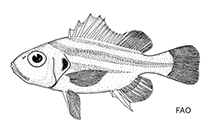
Pomadasys trifasciatus, Black-ear javelin

You can sponsor this page

Pomadasys trifasciatus Fowler, 1937

Black-ear javelin
Add your observation in Fish Watcher
Native range | All suitable habitat | Point map | Year 2050
This map was computer-generated and has not yet been reviewed.
Pomadasys trifasciatus   AquaMaps   Data sources: GBIF OBIS
Upload your photos and videos
Φωτογραφίες | Google image
Image of Pomadasys trifasciatus (Black-ear javelin)
Pomadasys trifasciatus
Picture by FAO

Classification / Names Κοινά ονόματα | Συνώνυμα | Catalog of Fishes(Γένος, Είδη) | ITIS | CoL | WoRMS | Cloffa

> Eupercaria/misc (Various families in series Eupercaria) > Haemulidae (Grunts) > Haemulinae
Etymology: Pomadasys: Greek, poma, -atos = cover, operculum + Greek, dasys = with hair (Ref. 45335).
More on author: Fowler.

Environment: milieu / climate zone / εύρος βάθους / distribution range Οικολογία

Θαλασσινό(ά); Υφάλμυρο βενθοπελαγικό. Tropical

Κατανομή Χώρες | Περιοχές FAO | Οικοσυστήματα | Παρουσίες | Σημειακός χάρτης | Εισαγωγές | Faunafri

Western Pacific: northern Australia, Thailand and Papua New Guinea.

Μέγεθος / Βάρος / Age

Γεννητική Ωρίμανση: Lm ?  range ? - ? cm

Βιολογία     Γλωσσάρι (π.χ. epibenthic)

Occurs in inshore waters of the continental shelf (Ref. 75154).

Life cycle and mating behavior Γεννητική Ωρίμανση | Αναπαραγωγή | Γεννοβολία | Αβγά | Γονιμότητα | Προνύμφες

Oviparous, distinct pairing during breeding (Ref. 205).

Main reference Upload your references | Αναφορές | Συντονιστής | Συνεργάτες

Kailola, P.J., 1987. The fishes of Papua New Guinea: a revised and annotated checklist. Vol. II Scorpaenidae to Callionymidae. Research Bulletin No. 41, Research Section, Dept. of Fisheries and Marine Resources, Papua New Guinea. (Ref. 6192)

IUCN Red List Status (Ref. 130435: Version 2025-1)

  Least Concern (LC) ; Date assessed: 16 July 2020

CITES

Not Evaluated

CMS (Ref. 116361)

Not Evaluated

Threat to humans

  Harmless


Human uses

FAO - Publication: search | FishSource |

Περισσότερες πληροφορίες

Τροφική Οικολογία
Food items (preys)
Σύσταση δίαιτας
Κατανάλωση τροφής
Food rations
Θηρευτές
Οικολογία
Οικολογία
Home ranges
Population dynamics
Παράμετροι Αύξησης
Max. ages / sizes
Length-weight rel.
Length-length rel.
Length-frequencies
Mass conversion
Στρατολόγηση
Αφθονία
Life cycle
Αναπαραγωγή
Γεννητική Ωρίμανση
Maturity/Gills rel.
Γονιμότητα
Γεννοβολία
Spawning aggregations
Αβγά
Egg development
Προνύμφες
Δυναμική προνυμφών
Κατανομή
Χώρες
Περιοχές FAO
Οικοσυστήματα
Παρουσίες
Εισαγωγές
BRUVS - Videos
Anatomy
Επιφάνεια βραγχίων
Brain
Otolith
Physiology
Body composition
Nutrients
Κατανάλωση οξυγόνου
Κολυμβητικός τύπος
Ταχύτητα κολύμβησης
Visual pigments
Fish sound
Diseases & Parasites
Toxicity (LC50s)
Γενετική
Genome
Γενετική
Heterozygosity
Κληρονομικότητα
Human related
Aquaculture systems
Προφίλ υδατοκαλλιεργειών
Στελέχοι
Ciguatera cases
Stamps, coins, misc.
Taxonomy
Κοινά ονόματα
Συνώνυμα
Μορφολογία
Μορφομετρία
Φωτογραφίες
Αναφορές
Αναφορές

Εργαλεία

Special reports

Download XML

Διαδικτυακές πηγές

AFORO (otoliths) | Aquatic Commons | BHL | Cloffa | Websites from users | Check FishWatcher | CISTI | Catalog of Fishes: Γένος, Είδη | DiscoverLife | ECOTOX | FAO - Publication: search | Faunafri | Fishipedia | Fishtrace | GloBI | Google Books | Google Scholar | Google | IGFA World Record | OneZoom | Open Tree of Life | Otolith Atlas of Taiwan Fishes | PubMed | Reef Life Survey | Socotra Atlas | TreeBase | Δέντρο Ζωής | Wikipedia: Go, αναζήτηση | Zoobank | Zoological Record

Estimates based on models

Preferred temperature (Αναφ. 123201): 25.6 - 29, mean 27.9 °C (based on 446 cells).
Phylogenetic diversity index (Αναφ. 82804):  PD50 = 0.5000   [Uniqueness, from 0.5 = low to 2.0 = high].
Bayesian length-weight: a=0.01479 (0.00693 - 0.03157), b=2.99 (2.82 - 3.16), in cm total length, based on LWR estimates for this Genus-body shape (Ref. 93245).
Τροφικό Επίπεδο (Αναφ. 69278):  3.5   ±0.5 se; based on size and trophs of closest relatives
Ελαστικότητα (Αναφ. 120179):  Μεσαίο(α), ελάχιστος χρόνος για διπλασιασμό πληθυσμού 1,4 - 4,4 έτη (Preliminary K or Fecundity.).
Fishing Vulnerability (Ref. 59153):  Low to moderate vulnerability (33 of 100). 🛈