>
Blenniiformes (Blennies) >
Tripterygiidae (Triplefin blennies) > Tripterygiinae
Etymology: Norfolkia: Named for the Norfolk Island ( In 1953 Henry W. Fowler named this new genus on a Collection of Fishes Made by Dr. Marshall Laird at Norfolk Island) (R.Bajol, pers.comm. 04/2016).
More on authors: McCulloch & Waite.
Environment: milieu / climate zone / djupintervall / distribution range
Ekologi
marina revassocierade; djupintervall 0 - 12 m (Ref. 13227). Subtropical
Southwest Pacific: Australia, including Lord Howe Island, Norfolk Island, Middleton Reef, and Elizabeth Reef; and New Caledonia.
Size / Vikt / Age
Könsmognad: Lm ? range ? - ? cm
Max length : 6.6 cm SL hane/ej könsbestämd; (Ref. 54980)
Short description
Bestämningsnycklar | Morfologi | Morfometri
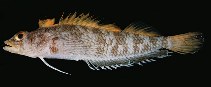
Taggstrålar i ryggfenan (totalt) : 18 - 19; Mjukstrålar i ryggfenan (totalt) : 10 - 11; Taggstrålar i analfenan: 2; Mjukstrålar i analfenan: 20 - 21. Head to eye and preopercle with scales; small and palmate supraorbital tentacle; light gray or light brown body with 2 linear series of uneven brown blotches with larger dorsal series and some upper blotches joining with lower; below eye is an oblique, dark brown bar with white margin; remainder of head dark brown, blending to white ventrally; females with oblique dark bands on second and third dorsal fins, darkening as they cross rays; uneven, vertical dark bars on caudal fin; yellow or orange dorsal and caudal fins in males. Dorsal rays IV + XIV-XV (typically XV) + 10-11 (typically 11); lateral line discontinuous, 21-24 + 14-19; mandibular pores 5-6 + 1 + 5-6 (Ref. 54980).
Body shape (shape guide): elongated.
Adults are found in intertidal pools in coral reef areas (Ref. 13227). Eggs are hemispherical and covered with numerous sticky threads that anchor them in the algae on the nesting sites (Ref. 240). Larvae are planktonic which occur primarily in shallow, nearshore waters (Ref. 94114).
Life cycle and mating behavior
Könsmognad | Reproduktion | Lek | Ägg | Fecundity | Larver
Fricke, R., 1994. Tripterygiid fishes of Australia, New Zealand and the southwest Pacific Ocean (Teleostei). Theses Zool. 24:1-585. (Ref. 13227)
IUCN Red List Status (Ref. 130435: Version 2025-1)
Threat to humans
Harmless
Human uses
Fiskeri: saknar intresse
Verktyg
Special reports
Download XML
Internet-källor
Estimates based on models
Preferred temperature (Ref.
123201): 23.2 - 27.9, mean 26.4 °C (based on 383 cells).
Phylogenetic diversity index (Ref.
82804): PD
50 = 0.5625 [Uniqueness, from 0.5 = low to 2.0 = high].
Bayesian length-weight: a=0.00617 (0.00288 - 0.01322), b=3.04 (2.86 - 3.22), in cm total length, based on LWR estimates for this (Sub)family-body shape (Ref.
93245).
Trofisk nivå (Ref.
69278): 3.2 ±0.4 se; based on size and trophs of closest relatives
Resiliens (Ref.
120179): Hög, lägsta populationsfördubblingstid mindre än 15 månader (Preliminary K or Fecundity.).
Fishing Vulnerability (Ref.
59153): Low vulnerability (10 of 100).
🛈
Nutrients (Ref.
124155): Calcium = 167 [66, 399] mg/100g; Iron = 1.29 [0.60, 2.61] mg/100g; Protein = 19.1 [17.8, 20.4] %; Omega3 = 0.147 [0.060, 0.365] g/100g; Selenium = 15.4 [4.9, 42.6] μg/100g; VitaminA = 47.7 [11.0, 220.5] μg/100g; Zinc = 2 [1, 3] mg/100g (wet weight);