Elasmobranchi (squali e razze) (sharks and rays) >
Rajiformes (Skates and rays) >
Rajidae (Skates)
Etymology: Amblyraja: Greek, amblys = darkness + Latin, raja, -ae = ray (Raja sp.) (Ref. 45335).
Eponymy: Professor Adolf Severin Jensen (1866–1953) was a Danish zoologist, ichthyologist and malacologist. [...] (Ref. 128868), visit book page.
Issue
Provisionally retained as valid but treated as junior synonym of A. hyperborea by Weigmann (2016, Ref. 106604) due to strong morphological similarity and preliminary molecular data. Further work is needed to resolve this issue (Ref. 118749).
Environment: milieu / climate zone / distribuzione batimetrica / distribution range
Ecologia
marino batidemersale; distribuzione batimetrica 165 - 3000 m (Ref. 114953). Deep-water; 67°N - 39°N, 72°W - 10°W (Ref. 114953)
Western Atlantic: Nova Scotia, Canada to southern New England, USA; Eastern Atlantic: Iceland (Ref. 12462); North Atlantic: Labrador Sea and off British Isles (Ref. 114953)
Size / Peso / Age
Maturità: Lm ? range ? - ? cm
Max length : 74.3 cm TL maschio/sesso non determinato; (Ref. 4926); 85.0 cm TL (female)
Short description
Chiavi di identificazione | Morfologia | Morfometria
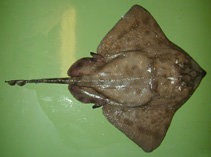
Lacks large thorns on anterior margins and mid posterior parts of pectorals and on either side of mid-dorsal ridge on the disc. Upper surface plain light brown, either grayish or of chocolate hue, darker along margins of fins. Lower surface brownish gray, grayish white or perhaps pure white (Ref. 6902).
Body shape (shape guide): other.
Benthic (Ref. 58426). Deep-water species. Prefers higher temperatures. Feeds on small fishes and crustaceans (Ref. 6902). Oviparous (Ref. 50449). Eggs have horn-like projections on the shell (Ref. 205). Maximum depth reported taken from Ref. 117245. It may be captured as by-catch in deep water fisheries, but due to its depth preference, it is less likely to be vulnerable (Ref. 117245).
Life cycle and mating behavior
Maturità | Riproduzione | Deposizione | Uova | Fecundity | Larve
Oviparous, paired eggs are laid. Embryos feed solely on yolk (Ref. 50449). Eggs have horn-like projections on the shell (Ref. 205).
McEachran, J.D. and K.A. Dunn, 1998. Phylogenetic analysis of skates, a morphologically conservative clade of elasmobranchs (Chondrichthyes: Rajidae). Copeia 1998(2):271-290. (Ref. 27314)
IUCN Red List Status (Ref. 130435: Version 2025-1)
Threat to humans
Harmless
Human uses
Strumenti
Special reports
Download XML
Fonti Internet
Estimates based on models
Preferred temperature (Fonte Biblio.
123201): 3.1 - 4, mean 3.6 °C (based on 69 cells).
Phylogenetic diversity index (Fonte Biblio.
82804): PD
50 = 0.5039 [Uniqueness, from 0.5 = low to 2.0 = high].
Bayesian length-weight: a=0.00302 (0.00141 - 0.00645), b=3.24 (3.07 - 3.41), in cm total length, based on LWR estimates for this (Sub)family-body shape (Ref.
93245).
Trophic level (Fonte Biblio.
69278): 3.7 ±0.57 se; based on food items.
Resilienza (Fonte Biblio.
120179): Basso, tempo minimo di raddoppiamento della popolazione 4.5 - 14 anni (Fec assumed to be <100).
Fishing Vulnerability (Ref.
59153): Moderate to high vulnerability (54 of 100).
🛈
Nutrients (Ref.
124155): Calcium = 4.4 [0.7, 91.3] mg/100g; Iron = 0.345 [0.032, 4.848] mg/100g; Protein = 14.9 [12.9, 17.0] %; Omega3 = 0.479 [0.188, 1.215] g/100g; Selenium = 18.7 [3.3, 89.1] μg/100g; VitaminA = 7.03 [0.51, 95.98] μg/100g; Zinc = 0.266 [0.018, 3.130] mg/100g (wet weight);