Klassifizierung / Names
Namen | Synonyme | Catalog of Fishes(Gattung, Arten) | ITIS | CoL | WoRMS | Cloffa
>
Cypriniformes (Carps) >
Leuciscidae (Minnows) > Pogonichthyinae
Etymology: Iotichthys: Taken from the Greek letter "iota", with the meaning of the least or in very small quantity + Greek, ichthys = fish (Ref. 45335).
More on author: Cope.
Environment: milieu / climate zone / Tiefenbereich / distribution range
Ökologie
; süßwasser demersal. Temperate; 10°C - 26°C (Ref. 2059); 42°N - 41°N
North America: Bonneville basin in northern Utah, USA.
Size / Gewicht / Alter
Geschlechtsreife: Lm ? range ? - ? cm
Max length : 6.4 cm TL Männchen/unbestimmt; (Ref. 86798)
Kurzbeschreibung
Bestimmungsschlüssel | Morphologie | Morphometrie
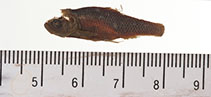
Afterflossenweichstrahlen: 8. Iotichthys phlegethontis can be distinguished by the following characters: no lateral line (rarely 1-2 pores at front); large scales (34-38 lateral); dorsal-fin origin behind pelvic-fin origin; slender peduncle; 8 anal-fin rays; pharyngeal teeth 2,5-4,2; large eye; short rounded snout; fairly deep, compressed body; color consists of olive above, black specks on back and side, gold stripe along blue side, white to yellow fins; and red-gold lower side, gold eye and anal fins in breeding males (Ref. 86798).
Inhabits marshes, ponds, vegetated areas of streams and lakes, usually over mud (Ref. 86798).
Life cycle and mating behavior
Geschlechtsreife | Fortpflanzung | Ablaichen | Eier | Fecundity | Larven
Page, L.M. and B.M. Burr, 2011. A field guide to freshwater fishes of North America north of Mexico. Boston : Houghton Mifflin Harcourt, 663p. (Ref. 86798)
IUCN Rote Liste Status (Ref. 130435: Version 2025-1)
Bedrohung für Menschen
Harmless
Nutzung durch Menschen
Tools
Zusatzinformationen
Download XML
Internet Quellen
Estimates based on models
Phylogenetic diversity index (Ref.
82804): PD
50 = 1.0000 [Uniqueness, from 0.5 = low to 2.0 = high].
Bayesian length-weight: a=0.01000 (0.00244 - 0.04107), b=3.04 (2.81 - 3.27), in cm total length, based on all LWR estimates for this body shape (Ref.
93245).
Trophic level (Ref.
69278): 3.0 ±0.4 se; based on size and trophs of closest relatives
Widerstandsfähigkeit (Ref.
120179): hoch, Verdopplung der Population dauert weniger als 15 Monate. (Preliminary K or Fecundity.).
Fishing Vulnerability (Ref.
59153): Low vulnerability (10 of 100).
🛈