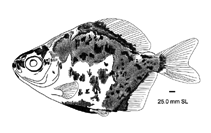
>
Characiformes (Characins) >
Serrasalmidae (Piranhas and pacus) > Myleinae
Etymology: Myloplus: Greek, mylos, -ou = grey mullet + Greek, plus, ploos = movement of a serpent.
Eponymy: Dr Carl Ternetz (1870–1928) was a Swiss-born ichthyologist and naturalist who first collected near Basel (1892) and subsequently collected in South America over a period of more than thirty years (from c. [...] (Ref. 128868), visit book page.
More on author: Norman.
Issue
See Le Bail, P.-Y., A. Margeridon, C. Cauty, P. Planquette, E. Prevost and M. Loir (1989) for reproductive biology.
Environment: milieu / climate zone / rango de profundidad / distribution range
Ecología
; agua dulce bentopelágico; pH range: 6.0 - 7.2; dH range: ? - 15; potamodromo (Ref. 51243). Tropical; 20°C - 25°C (Ref. 2060)
South America: east and northeast Guiana Shield rivers.
Tamaño / Peso / Age
Madurez: Lm ? range ? - ? cm
Max length : 23.1 cm SL macho / no sexado; (Ref. 39031)
Prefers lentic waters where the river banks are steep. Feeds on the leaves of river plants. During the short rainy season, a third of its diet consists of flowers and seeds which they find in the flood zones of the forest (Ref. 12225). The small larvae are zooplanktivores. Reproduction is asynchronous and lasts year round. However, spawning frequency is clearly higher during the rainy season. Is a likely candidate for fish breeding studies (Ref. 27188).
Life cycle and mating behavior
Madurez | Reproducción | Puesta | Huevos | Fecundidad | Larva
Jégu, M., 2003. Serrasalminae (Pacus and piranhas). p. 182-196. In R.E. Reis, S.O. Kullander and C.J. Ferraris, Jr. (eds.) Checklist of the Freshwater Fishes of South and Central America. Porto Alegre: EDIPUCRS, Brasil. (Ref. 39031)
IUCN Red List Status (Ref. 130435: Version 2025-1)
Threat to humans
Harmless
Human uses
Acuicultura: posible uso futuro
Herramientas
Special reports
Download XML
Fuentes de Internet
Estimates based on models
Phylogenetic diversity index (Referencia
82804): PD
50 = 0.5001 [Uniqueness, from 0.5 = low to 2.0 = high].
Bayesian length-weight: a=0.02754 (0.01279 - 0.05932), b=2.97 (2.79 - 3.15), in cm total length, based on LWR estimates for this Genus-body shape (Ref.
93245).
Nivel trófico (Referencia
69278): 2.0 ±0.00 se; based on food items.
Resiliencia (Referencia
120179): Alto, población duplicada en un tiempo mínimo inferior a 15 meses (tm=1).
Fishing Vulnerability (Ref.
59153): Low vulnerability (18 of 100).
🛈