This website uses cookies to enhance your browsing experience and ensure the functionality of our site. For more detailed information about the types of cookies we use and how we protect your privacy, please visit our Privacy Information page.
×
Cookie Settings
This website uses different types of cookies to enhance your experience. Please select your preferences below:
> Gobiiformes (Gobies) > Gobiidae (Gobies) > Gobiinae
Etymology: Trimma:Greek, trimma, -atos = something crushed (Ref. 45335); benjamini:Named for Peter Benjamin, Toronto entrepreneur, Benjamin Films Ltd (Ref. 100726). Eponymy: Peter Benjamin owns Benjamin Film Laboratory (Toronto), and is a keen amateur ichthyologist. He provided Winterbottom with free 35mm film and processing over two decades and has participated in several collecting expeditions. (Ref. 128868), visit book page. More on author: Winterbottom.
Ambiente: milieu / zona climática / intervalo de profundidade / gama de distribuição Ecologia
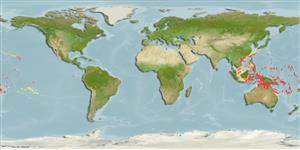
marinhas associadas(os) a recifes; intervalo de profundidade 1 - 90 m (Ref. 86942), usually 4 - 35 m (Ref. 90102). Tropical
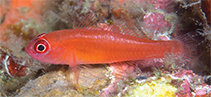
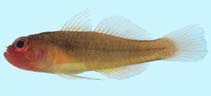
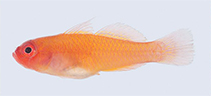
Espinhos dorsais (total) : 7; Raios dorsais moles (total) : 9 - 10; Espinhos anais: 1; Raios anais moles: 8 - 10. Distinguished by having the following characters: a deep concave, ‘U’-shaped interorbital trench; the bony interorbital about half pupil-diameter in width; with a slight groove posterodorsal to the eye; without median predorsal scales, sides of nape covered with small scales reaching to or near to the eyes; cheek and operculum without scales; base of pectoral-fin with oval, moderate-sized scales; prepelvic area with 5-6 rows of cycloid scales, isthmus naked anteriorly, with one slightly enlarged scale on the membrane between the bases of the pelvic fins; central 6-13 pectoral rays branched, uppermost and lowermost rays unbranched; fifth pelvic-fin ray branched once dichotomously and about 60-75% length of the fourth; all other rays usually with one sequential branch, basal membrane connecting the two pelvic fins only at the base; second dorsal spine longest, usually filamentous, extending at most to midway along the base of the second dorsal fin in Australian material; D2 usually I,10; A usually I, 9; nape crest fleshy from the first dorsal origin to above the operculum; when alive, head and body red, preserved yellow, the head with a thin vertical grey (bluish grey in life) bar from the anteroventral margin of the eye to the middle of the jaws and a second bar extending more-or-less vertically downward onto cheek from about the middle of the eye (often persisting in preserved material as faint grey bars); orbit rimmed with a thin band of melanophores, more distinct dorsally but faded in preserved material (Ref. 100726). Cross section: oval.
Specimens were collected with rotenone (Ref. 13702). Inhabits coastal and outer reef slopes (Ref. 37816, 48637). Benthic, occuring singly or in loose groups, and a plankton-feeder; with prolonged pelagic larval duration of 33.9 days (= 24% of maximum lifespan) and linear post-larval growth; daily mortality rate ranging from 2.9% to 6.3%; sex ratio of 1:1.6 male/females) (Ref. 87294).
Ciclo de vida e comportamento de acasalamento Maturidade | Reprodução | Desova | Ovos | Fecundidade | Larvas
Ciclo de vida Reprodução Maturidade Maturidade/Rel. das guelras Fecundidade Desova Agregações de desova Ovos Desenvolvimento dos ovos Larvas Dinâmica larvar
Fisiologia Composição corporal Nutrientes Consumo de oxigénio Tipo de natação Velocidade de natação Pigmentos visuais Som de peixe Doenças e Parasitas Toxicidade (LC50s)
Temperatura preferida (Ref. 123201): 25.4 - 28.9, mean 27.7 °C (based on 442 cells).
Índice de diversidade filogenética (Ref. 82804): PD50 = 0.5000 [Uniqueness, from 0.5 = low to 2.0 = high].
Bayesian length-weight: a=0.01023 (0.00477 - 0.02194), b=3.01 (2.83 - 3.19), in cm total length, based on LWR estimates for this (Sub)family-body shape (Ref. 93245).
Generation time: 0.1 ( na - na) years. Estimated as median ln(3)/K based on 1 growth studies.
Resiliência (Ref. 120179): Elevada, tempo mínimo de duplicação da população menor que 15 meses (Preliminary K or Fecundity.).
Vulnerabilidade da pesca (Ref. 59153): Low vulnerability (10 of 100). 🛈