>
Cypriniformes (Carps) >
Leuciscidae (Minnows) > Pogonichthyinae
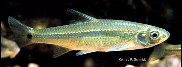
Etymology: Notropis: A misnomer given by Rafinesque to shriveled specimens, with the meaning of "back keel"; from Greek, noton = back (Ref. 45335).
Environment: milieu / climate zone / εύρος βάθους / distribution range
Οικολογία
; Γλυκού νερού; Υφάλμυρο βενθοπελαγικό. Temperate; 10°C - 24°C (Ref. 13614); 67°N - 31°N
North America: St. Lawrence River in Quebec, Canada to Altamaha and upper Chattahoochee River in Georgia, USA; Hudson Bay, Great Lakes, and Mississippi River basins from Ontario, Canada to Mackenzie River drainage in Canada and south to northern Ohio, southern Illinois and northeastern Montana, USA.
Μέγεθος / Βάρος / Age
Γεννητική Ωρίμανση: Lm ? range ? - ? cm
Max length : 15.0 cm TL αρσενικό/απροσδιόριστο; (Ref. 5723); common length : 9.0 cm TL αρσενικό/απροσδιόριστο; (Ref. 12193); μεγ. αναφερόμενη ηλικία: 5 έτη (Ref. 12193)
Inhabit sandy and rocky pools and runs of small to large rivers. Also found in sandy and rocky shores of lakes and in creeks on Atlantic Slope. Omnivorous, principally feeds on insects, crustaceans, plants and algae (Ref. 27549).
Life cycle and mating behavior
Γεννητική Ωρίμανση | Αναπαραγωγή | Γεννοβολία | Αβγά | Γονιμότητα | Προνύμφες
Page, L.M. and B.M. Burr, 1991. A field guide to freshwater fishes of North America north of Mexico. Houghton Mifflin Company, Boston. 432 p. (Ref. 5723)
IUCN Red List Status (Ref. 130435: Version 2025-1)
Threat to humans
Harmless
Human uses
αλιεία: Εμπορικό(ά); Ενυδρείο: Δημόσια ενυδρεία
Εργαλεία
Special reports
Download XML
Διαδικτυακές πηγές
Estimates based on models
Phylogenetic diversity index (Αναφ.
82804): PD
50 = 0.5000 [Uniqueness, from 0.5 = low to 2.0 = high].
Bayesian length-weight: a=0.00603 (0.00347 - 0.01045), b=3.12 (2.96 - 3.28), in cm total length, based on LWR estimates for this species & (Sub)family-body (Ref.
93245).
Τροφικό Επίπεδο (Αναφ.
69278): 2.1 ±0.1 se; based on diet studies.
Ελαστικότητα (Αναφ.
120179): Μεσαίο(α), ελάχιστος χρόνος για διπλασιασμό πληθυσμού 1,4 - 4,4 έτη (tmax=5).
Fishing Vulnerability (Ref.
59153): Low vulnerability (10 of 100).
🛈