>
Perciformes/Zoarcoidei (Eelpouts and pricklebacks) >
Zoarcidae (Eelpouts) > Lycodinae
Etymology: Lycodes: Greek, lykos = wolf + Greek, suffix, oides = similar to (Ref. 45335); cortezianus: Named for the Cortez Bank, off San Diego, California (Ref. 4925).
Eponymy: The etymologies do not help, but we believe these species are named after the Sea of Cortez where the holotypes were caught, or in the case of the eelpout, Cortez Bank off San Diego, California. (Ref. 128868), visit book page.
More on author: Gilbert.
Environment: milieu / climate zone / rango de profundidad / distribution range
Ecología
marino batidemersal; rango de profundidad 73 - 620 m (Ref. 2850). Deep-water
Eastern Pacific: Prince of Wales Island, Alaska to San Diego, California, USA.
Tamaño / Peso / Age
Madurez: Lm ? range ? - ? cm
Max length : 50.0 cm TL macho / no sexado; (Ref. 2850)
Short description
Claves de identificación | Morfología | Morfometría
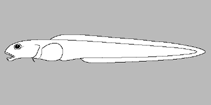
Espinas dorsales (total) : 0; Radios blandos dorsales (total) : 105 - 108; Espinas anales: 0; Radios blandos anales: 89 - 93. Caudal rounded but not clearly distinguished from dorsal and anal fins; pectorals large; pelvic fins much reduced (Ref. 6885). Brown to blue black on back and sides, lighter ventrally; white on scale pockets; dark above base of pectoral fins; black along anterior border of dorsal fin, on posterior parts of dorsal and anal fins, and on caudal; light margins on pectoral fins (Ref. 6885).
Body shape (shape guide): elongated.
Found on muddy bottoms (Ref. 2850).
Life cycle and mating behavior
Madurez | Reproducción | Puesta | Huevos | Fecundidad | Larva
Anderson, M.E., 1994. Systematics and osteology of the Zoarcidae (Teleostei: Perciformes). Ichthyol. Bull. J.L.B. Smith Inst. Ichthyol. 60:120 p. (Ref. 11954)
IUCN Red List Status (Ref. 130435: Version 2025-1)
Threat to humans
Harmless
Human uses
Herramientas
Special reports
Download XML
Fuentes de Internet
Estimates based on models
Preferred temperature (Referencia
123201): 5 - 8.7, mean 6.5 °C (based on 52 cells).
Phylogenetic diversity index (Referencia
82804): PD
50 = 0.5000 [Uniqueness, from 0.5 = low to 2.0 = high].
Bayesian length-weight: a=0.00269 (0.00141 - 0.00516), b=3.22 (3.06 - 3.38), in cm total length, based on LWR estimates for this Genus-body shape (Ref.
93245).
Nivel trófico (Referencia
69278): 3.5 ±0.5 se; based on size and trophs of closest relatives
Resiliencia (Referencia
120179): Muy bajo, población duplicada en un tiempo mínimo superior a 14 años (Preliminary K or Fecundity.).
Fishing Vulnerability (Ref.
59153): Moderate vulnerability (40 of 100).
🛈