This website uses cookies to enhance your browsing experience and ensure the functionality of our site. For more detailed information about the types of cookies we use and how we protect your privacy, please visit our Privacy Information page.
×
Cookie Settings
This website uses different types of cookies to enhance your experience. Please select your preferences below:
> Cyprinodontiformes (Rivulines, killifishes and live bearers) > Poeciliidae (Poeciliids) > Poeciliinae
Etymology: Poecilia:Greek, poikilos = with a lot of colours (Ref. 45335). More on author: Lesueur.
Umwelt: Milieu / Klimazone / Tiefenbereich / Verbreitungsgebiet Ökologie
North America: Cape Fear drainage in North Carolina, USA to Veracruz, Mexico. Introduced to many countries. Several countries report adverse ecological impact after introduction. Gulf of Mexico (Ref. 26938).
Länge bei der ersten Reifung / Größe / Gewicht / Alter
Geschlechtsreife: Lm6.7, range 5 - 9.5 cm Max length : 15.0 cm TL Männchen/unbestimmt; (Ref. 5723); 10.0 cm TL (female); common length : 3.4 cm TL Männchen/unbestimmt; (Ref. 12193)
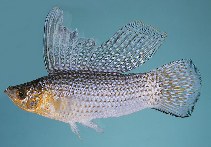
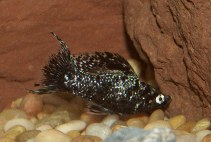
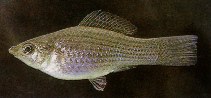
The large sail-like dorsal fin of the male is the most distinctive characteristic of this fish; coloration can vary from green, gray to jet black; speckled forms also common (Ref. 44091). Body shape (shape guide): fusiform / normal.
Adults are found in still or gently flowing warm water of small creeks and drains (Ref. 44894). They occur in ponds, lakes, sloughs, and quiet, often vegetated, backwaters and pools of streams (Ref. 5723) and also in coastal waters (Ref. 7251). Abundant in tidal ditches and brackish canals. They feed mainly on algae (Refs. 7251; 44091), also consumes animal material: rotifers, small crustaceans (such as copepods and ostracods) and aquatic insects (Ref. 79012). Migratory behaviour is undetermined (Ref. 126106).
Page, L.M. and B.M. Burr, 1991. A field guide to freshwater fishes of North America north of Mexico. Houghton Mifflin Company, Boston. 432 p. (Ref. 5723)
IUCN Rote Liste Status (Ref. 130435: Version 2025-2 (Global))
Phylogenetischer Diversitätsindex (Ref. 82804): PD50 = 0.5000 [Uniqueness, from 0.5 = low to 2.0 = high].
Bayesian length-weight: a=0.01288 (0.00760 - 0.02184), b=3.05 (2.91 - 3.19), in cm total length, based on LWR estimates for this species & Genus-body shape (Ref. 93245).
Trophische Ebene (Ref. 69278): 2.0 ±0.00 se; based on food items.
Widerstandsfähigkeit (Ref. 120179): hoch, Verdopplung der Population dauert weniger als 15 Monate. (tm<1; mutiple spawning per year; Fec=10--300).
Anfälligkeit der Fischerei (Ref. 59153): Low vulnerability (10 of 100). 🛈