>
Holocentriformes (Squirrelfishes, soldierfishes) >
Holocentridae (Squirrelfishes, soldierfishes) > Holocentrinae
Etymology: Neoniphon: Greek, neos = new + Greek, niphon = to snow (Ref. 45335).
More on author: Poey.
Environment: milieu / climate zone / rango de profundidad / distribution range
Ecología
marino asociado a arrecife; rango de profundidad 1 - 30 m (Ref. 9710), usually ? - 22 m (Ref. 3156). Tropical; 33°N - 7°N, 99°W - 58°W
Western Atlantic: Bermuda and Florida, USA to northern South America.
Tamaño / Peso / Age
Madurez: Lm ? range ? - ? cm
Max length : 15.0 cm TL macho / no sexado; (Ref. 26340)
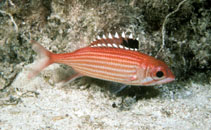
Espinas dorsales (total) : 11; Radios blandos dorsales (total) : 12; Espinas anales: 4; Radios blandos anales: 8. Body slender, sides compressed. Snout spinules prominent, spine extending into the posterior narial opening. White stripes on upper sides narrow, separated by broader dark bands (Ref. 37108). Body with alternate stripes of red and silvery white; spinous dorsal fin red, white at tips, with a large black spot between the first 3 or 4 spines (Ref. 13442).
Body shape (shape guide): fusiform / normal.
Inhabit sandy, rocky and coral bottoms (Ref. 5521). More common on seaward reefs than on protected reefs. Retreat into recesses when alarmed (Ref. 9710). Nocturnal (Ref. 37108). Secretive, found deep in crevices between branches of live corals (Ref. 26938). Oviparous, with planktonic eggs and larvae (Ref. 240).
Life cycle and mating behavior
Madurez | Reproducción | Puesta | Huevos | Fecundidad | Larva
Smith-Vaniz, W.F., B.B. Collette and B.E. Luckhurst, 1999. Fishes of Bermuda: history, zoogeography, annotated checklist, and identification keys. American Society of Ichthyologists and Herpetologists Special Publication No. 4. 424 p. (Ref. 35505)
IUCN Red List Status (Ref. 130435: Version 2025-1)
Threat to humans
Reports of ciguatera poisoning (Ref. 30303)
Human uses
Pesquerías: comercial
Herramientas
Special reports
Download XML
Fuentes de Internet
Estimates based on models
Preferred temperature (Referencia
123201): 25.3 - 28.1, mean 27 °C (based on 158 cells).
Phylogenetic diversity index (Referencia
82804): PD
50 = 0.5039 [Uniqueness, from 0.5 = low to 2.0 = high].
Bayesian length-weight: a=0.01479 (0.00929 - 0.02354), b=2.97 (2.84 - 3.10), in cm total length, based on LWR estimates for this species & Genus-body shape (Ref.
93245).
Nivel trófico (Referencia
69278): 3.6 ±0.5 se; based on diet studies.
Resiliencia (Referencia
120179): Alto, población duplicada en un tiempo mínimo inferior a 15 meses (Preliminary K or Fecundity.).
Fishing Vulnerability (Ref.
59153): Low vulnerability (10 of 100).
🛈
Nutrients (Ref.
124155): Calcium = 84.1 [33.3, 337.9] mg/100g; Iron = 0.636 [0.249, 1.978] mg/100g; Protein = 18.6 [17.3, 19.7] %; Omega3 = 0.151 [0.065, 0.351] g/100g; Selenium = 31.3 [17.7, 62.0] μg/100g; VitaminA = 78.2 [28.3, 219.0] μg/100g; Zinc = 2.29 [0.96, 4.45] mg/100g (wet weight);