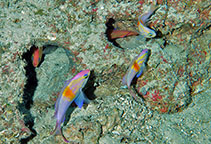
Pronotogrammus martinicensis, Roughtongue bass

You can sponsor this page

Pronotogrammus martinicensis (Guichenot, 1868)

Roughtongue bass
Add your observation in Fish Watcher
Native range | All suitable habitat | Point map | Year 2050
This map was computer-generated and has not yet been reviewed.
Pronotogrammus martinicensis   AquaMaps   Data sources: GBIF OBIS
Upload your photos and videos
Bilder | Google image
Image of Pronotogrammus martinicensis (Roughtongue bass)
Pronotogrammus martinicensis
Picture by Baldwin, C.C.

Classification / Names Populärnamn | synonymer | Catalog of Fishes(Släkte, Arter) | ITIS | CoL | WoRMS | Cloffa

> Perciformes/Serranoidei (Groupers) > Anthiadidae (Fairy basslets or Streamer basses)
Etymology: Pronotogrammus: Greek, pro = first, in front of + Greek, noton = back + Greek, gramma = signal, letter (Ref. 45335).
More on author: Guichenot.

Environment: milieu / climate zone / djupintervall / distribution range Ekologi

marina bottenlevande; djupintervall 65 - 230 m (Ref. 34841). Tropical; 32°N - 36°S

Utbredning Länder | FAO områden | Ekosystem | Förekomster | Prickkarta | Utplanteringar | Faunafri

Western Atlantic: Florida, USA and Bermuda through the Greater Antilles to Rio Grande, Brazil (Ref. 47377).

Size / Vikt / Age

Könsmognad: Lm ?  range ? - ? cm
Max length : 20.0 cm TL hane/ej könsbestämd; (Ref. 7251); common length : 16.0 cm TL hane/ej könsbestämd; (Ref. 5217); rapporterad maxålder: 15 år (Ref. 96848)

Short description Bestämningsnycklar | Morfologi | Morfometri

Taggstrålar i ryggfenan (totalt) : 10; Mjukstrålar i ryggfenan (totalt) : 13 - 16; Taggstrålar i analfenan: 3; Mjukstrålar i analfenan: 7 - 8; Ryggkotor: 26.
Body shape (shape guide): fusiform / normal.

Biologi     Ordlista (t.ex. epibenthic)

Adults are commonly found on outer continental shelf reefs. They primarily feed on zooplankton while common in the diet of larger predators like snappers and groupers (Ref. 96848).

Life cycle and mating behavior Könsmognad | Reproduktion | Lek | Ägg | Fecundity | Larver

Are monandric (males are secondary), protogynous hermaphrodites. About 50% of females transform into males at 7.63 cm SL and 1.0 yr of age (Ref. 96848). During the spawning period, oocytes are found to be in different stages of development indicating asynchronous oocyte development and indeterminate fecundity (Ref. 96848).

Main reference Upload your references | referenser | Koordinator | Medarbetare

Anderson, W.D. Jr. and P.C. Heemstra, 1980. Two new species of Western Atlantic Anthias (Pisces: Serranidae), redescription of A. asperilinguis and review of Holanthias martinicensis. Copeia 1980(1):72-87. (Ref. 34841)

IUCN Red List Status (Ref. 130435: Version 2025-1)

  Least Concern (LC) ; Date assessed: 23 August 2012

CITES

Not Evaluated

CMS (Ref. 116361)

Not Evaluated

Threat to humans

  Harmless


Human uses

Fiskeri: saknar intresse
FAO - Publication: search | FishSource |

Ytterligare information

Trophic ecology
Food items (preys)
Födosammansättning
Födointag
Food rations
Predatorer
Ekologi
Ekologi
Home ranges
Population dynamics
Tillväxtparametrar
Max. ages / sizes
Length-weight rel.
Length-length rel.
Length-frequencies
Mass conversion
Rekrytering
Abundans
Life cycle
Reproduktion
Könsmognad
Maturity/Gills rel.
Fecundity
Lek
Spawning aggregations
Ägg
Egg development
Larver
Larvdynamik
Utbredning
Länder
FAO områden
Ekosystem
Förekomster
Utplanteringar
BRUVS - Videos
Anatomy
Gälyta
Brain
Otolith
Physiology
Body composition
Nutrients
Syreförbrukning
Swimming type
Simhastighet
Visual pigments
Fish sound
Diseases & Parasites
Toxicity (LC50s)
Genetik
Genome
Genetik
Heterozygosity
Ärftlighet
Human related
Aquaculture systems
Vattenbruksprofiler
Avelslinjer
Ciguatera cases
Stamps, coins, misc.
Outreach
Medarbetare
referenser
referenser

Verktyg

Special reports

Download XML

Internet-källor

AFORO (otoliths) | Alien/Invasive Species database | Aquatic Commons | BHL | Cloffa | Websites from users | Check FishWatcher | CISTI | Catalog of Fishes: Släkte, Arter | DiscoverLife | ECOTOX | FAO - Publication: search | Faunafri | Fishipedia | Fishtrace | GloBI | GoMexSI (interaction data) | Google Books | Google Scholar | Google | IGFA World Record | OneZoom | Open Tree of Life | Otolith Atlas of Taiwan Fishes | PubMed | Reef Life Survey | Socotra Atlas | TreeBase | Tree of Life | Wikipedia: Go, sök | Zoological Record

Estimates based on models

Preferred temperature (Ref. 123201): 17.3 - 25.8, mean 21.2 °C (based on 86 cells).
Phylogenetic diversity index (Ref. 82804):  PD50 = 0.6250   [Uniqueness, from 0.5 = low to 2.0 = high].
Bayesian length-weight: a=0.02042 (0.01110 - 0.03755), b=3.01 (2.84 - 3.18), in cm total length, based on LWR estimates for this species & (Sub)family-body (Ref. 93245).
Trofisk nivå (Ref. 69278):  3.5   ±0.5 se; based on size and trophs of closest relatives
Generation time: 5.5 ( na - na) years. Estimated as median ln(3)/K based on 2 growth studies.
Resiliens (Ref. 120179):  Mellan, lägsta populationsfördubblingstid 1,4-4,4 år (Preliminary K or Fecundity.).
Fishing Vulnerability (Ref. 59153):  Low vulnerability (22 of 100). 🛈