This website uses cookies to enhance your browsing experience and ensure the functionality of our site. For more detailed information about the types of cookies we use and how we protect your privacy, please visit our Privacy Information page.
×
Cookie Settings
This website uses different types of cookies to enhance your experience. Please select your preferences below:
> Centrarchiformes (Basses) > Centrarchidae (Sunfishes)
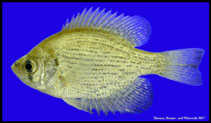
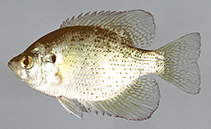
Etymology: Centrarchus:Greek, kentron = sting + Greek, archos = anus (Ref. 45335); macropterus:macropterus meaning large fin (Ref. 10294). More on author: Lacepède.
Environnement : milieu / zone climatique / profondeur / gamme de distribution Écologie
North America: occurs only in the USA from Potomac River drainage in Maryland to central Florida and west to Trinity River in Texas; north in Former Mississippi Embayment to southern Illinois and southern Indiana.
Taille / Poids / Âge
Maturité: Lm? range ? - ? cm Max length : 29.2 cm TL mâle / non sexé; (Ref. 40637); common length : 13.0 cm TL mâle / non sexé; (Ref. 12193); poids max. publié: 560.00 g (Ref. 4699); âge max. reporté: 6 années (Ref. 72462)
Occur in swamps, vegetated lakes, ponds, sloughs and backwaters and pools of creeks and small rivers, usually over mud (Ref. 5723, 10294). Invertivore: feed mainly on Hemiptera and Corixidae (Ref. 79012).
Cycle de vie et comportement reproducteur Maturité | Reproduction | Frai | Œufs | Fécondité | Larves
Page, L.M. and B.M. Burr, 1991. A field guide to freshwater fishes of North America north of Mexico. Houghton Mifflin Company, Boston. 432 p. (Ref. 5723)
Statut dans la liste rouge de l'IUCN (Ref. 130435: Version 2025-2 (Global))
Cycle de vie Reproduction Maturité Maturité/épines rel. Fécondité Frai Agrégats de frai Œufs Développement de l'œuf Larves Dynamique des populations larvaires
Physiologie Composition corporelle Nutriments Consommation d'oxygène Type de natation Vitesse de nage Pigments visuels Son de poisson Maladies et parasites Toxicité (CL50)
Indice de diversité phylogénétique (Réf. 82804): PD50 = 1.0000 [Uniqueness, from 0.5 = low to 2.0 = high].
Bayesian length-weight: a=0.01288 (0.00604 - 0.02750), b=3.09 (2.91 - 3.27), in cm total length, based on LWR estimates for this (Sub)family-body shape (Ref. 93245).
Niveau trophique (Réf. 69278): 3.2 ±0.38 se; based on food items.
Résilience (Réf. 120179): Milieu, temps minimum de doublement de population : 1,4 à 4,4 années (tmax=6;).
Vulnérabilité de la pêche (Ref. 59153): Low vulnerability (19 of 100). 🛈