Classification / Names
Common names | Synonyms | Catalog of Fishes(genus, species) | ITIS | CoL | WoRMS | Cloffa
Teleostei (teleosts) >
Ovalentaria/misc (Various families in series Ovalentaria) >
Embiotocidae (Surfperches)
Etymology: Phanerodon: Greek, phaner, -eros = visible + Greek, odous = teeth (Ref. 45335).
More on author: Girard.
Environment: milieu / climate zone / depth range / distribution range
Ecology
Marine; demersal; depth range ? - 46 m (Ref. 2850). Subtropical; 61°N - 28°N, 147°W - 113°W
Eastern Pacific: Wrangell, southeastern Alaska to Guadalupe Island, off north-central Baja California, Mexico.
Size / Weight / Age
Maturity: Lm ? range ? - ? cm
Max length : 44.2 cm SL male/unsexed; (Ref. 27436)
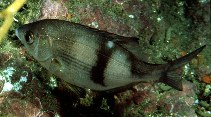
Dorsal spines (total): 9 - 11; Dorsal soft rays (total): 21 - 25; Anal spines: 3; Anal soft rays: 27 - 30; Vertebrae: 33 - 38. Above, dark gray or brown pigment with a silvery luster which dominates the color on sides and belly; darker blotches on the back and sides, dark vertical bars on juveniles; fins dusky (Ref. 6885).
Body shape (shape guide): short and / or deep.
Adults occur in rocky shores, often around kelp, pilings and underwater structures (Ref. 2850). Feed on hard-shelled mollusks, crabs and barnacles (Ref. 2850). Viviparous, female carries the developing young (Ref. 205).
Life cycle and mating behavior
Maturity | Reproduction | Spawning | Eggs | Fecundity | Larvae
Viviparous, female carries the developing young (Ref. 205).
Eschmeyer, W.N., E.S. Herald and H. Hammann, 1983. A field guide to Pacific coast fishes of North America. Boston (MA, USA): Houghton Mifflin Company. xii+336 p. (Ref. 2850)
IUCN Red List Status (Ref. 130435: Version 2025-2)
Threat to humans
Harmless
Human uses
Fisheries: commercial; gamefish: yes; aquarium: public aquariums
Tools
Special reports
Download XML
Internet sources