>
Eupercaria/misc (Various families in series Eupercaria) >
Labridae (Wrasses) > Corinae
Etymology: Halichoeres: Greek, als, alis = salt + Greek, choiros = pig (Ref. 45335).
More on author: Poey.
Environment: milieu / climate zone / distribuzione batimetrica / distribution range
Ecologia
marino associati a barriera corallina; distribuzione batimetrica 5 - 25 m (Ref. 9626). Tropical; 32°N - 9°N, 98°W - 59°W
Western Atlantic: southern Florida, USA and Bahamas to northern South America.
Size / Peso / Age
Maturità: Lm ? range ? - ? cm
Max length : 13.0 cm TL maschio/sesso non determinato; (Ref. 7251)
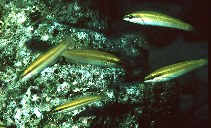
Spine dorsali (totale) : 9; Raggi dorsali molli (totale) : 11; Spine anali: 3; Raggi anali molli: 12. The common color phase is white or yellow with two yellowish brown stripes, one along back next to base of dorsal fin and one on upper side which extends through eye to end of snout. Large adult males are blue-green to yellowish green on the upper half of body and pale blue on lower half; blue stripes on head; a large black spot at caudal base (Ref. 13442).
Body shape (shape guide): fusiform / normal.
Inhabits coral reefs, normally high above the bottom. Swims with worm-like movements. Feeds on various invertebrates. A protogynous hermaphrodite (Ref. 55367). Generally of no interest to fisheries because of its small average size (Ref. 5217).
Life cycle and mating behavior
Maturità | Riproduzione | Deposizione | Uova | Fecundity | Larve
Diandric. Forms leks during breeding (Ref. 55367). Length at sex change = 7.9 cm TL (Ref. 55367).
Robins, C.R. and G.C. Ray, 1986. A field guide to Atlantic coast fishes of North America. Houghton Mifflin Company, Boston, U.S.A. 354 p. (Ref. 7251)
IUCN Red List Status (Ref. 130435: Version 2025-1)
Threat to humans
Harmless
Human uses
Pesca: commerciale; Acquario: Commerciale
Strumenti
Special reports
Download XML
Fonti Internet
Estimates based on models
Preferred temperature (Fonte Biblio.
123201): 26.3 - 28.2, mean 27.4 °C (based on 512 cells).
Phylogenetic diversity index (Fonte Biblio.
82804): PD
50 = 0.5000 [Uniqueness, from 0.5 = low to 2.0 = high].
Bayesian length-weight: a=0.00977 (0.00468 - 0.02039), b=3.09 (2.92 - 3.26), in cm total length, based on LWR estimates for this Genus-body shape (Ref.
93245).
Trophic level (Fonte Biblio.
69278): 3.5 ±0.37 se; based on food items.
Resilienza (Fonte Biblio.
120179): Alto, tempo minimo di raddoppiamento della popolazione meno di 15 mesi (Preliminary K or Fecundity.).
Fishing Vulnerability (Ref.
59153): Low vulnerability (10 of 100).
🛈
Nutrients (Ref.
124155): Calcium = 97.5 [57.8, 166.9] mg/100g; Iron = 0.762 [0.440, 1.418] mg/100g; Protein = 18.5 [15.6, 20.7] %; Omega3 = 0.159 [0.101, 0.255] g/100g; Selenium = 22.1 [12.9, 40.7] μg/100g; VitaminA = 151 [47, 560] μg/100g; Zinc = 1.79 [1.22, 2.81] mg/100g (wet weight);